


FUJI Sakura F-Type / S-Type Cermet Saw Blades are metal-cutting circular saw blades available in 305, 355 and 405 mm diameters. Select F-Type for general steel and S-Type for stainless steel. Match the exact blade model to the material, section size and an approved metal-cutting saw; maximum speed varies by model.
The Sakura series uses cermet (ceramic-metal composite) cutting tips. Cutting teeth remove chips rather than wearing through the workpiece like an abrasive disc. Confirm machine approval for tipped blades, blade diameter, bore, flanges, guard and operating speed before ordering. A matching bore alone does not establish compatibility.

Choosing the right blade type is critical for performance. Use the table below to select your model:
| Model | Target Material | Best For |
|---|---|---|
| Sakura F-Type (Standard) | Carbon Steel, Mild Steel, Iron | Angle iron, Channel steel, C-channel, Steel pipe, Round bar |
| Sakura S-Type (Specialty) | Stainless Steel (SUS304) | Stainless steel tubes and profiles within the machine cutting capacity |
Source: FUJI 2025 general catalog, printed page 40. Dimensions are outer diameter × cutting thickness × bore. Maximum rpm is a limit, not a universal recommended operating speed. Contact us for a current quotation and availability.
The standard choice for general steel fabrication. Features optimized tooth pitch for fast chip evacuation.

| Model | Dimensions (mm) | Teeth (T) | Max RPM | Package |
|---|---|---|---|---|
| Sakura-305FG | 305 x 2.0 x 25.4 | 60 | 3600* | 10 pcs |
| Sakura-355F | 355 x 2.4 x 25.4 | 64 | 1400 | 10 pcs |
| Sakura-405F | 405 x 2.8 x 25.4 | 80 | 1000 | 10 pcs |
*Note: 305FG supports higher RPM for specific machines, but 1500 RPM is recommended for longevity.
Choose S-Type for stainless steel. Maintain stable clamping and follow the blade and machine instructions for feed and permissible workpiece dimensions.

| Model | Dimensions (mm) | Teeth (T) | Max RPM | Package |
|---|---|---|---|---|
| Sakura-305S | 305 x 2.2 x 25.4 | 80 | 1500 | 1 pc |
| Sakura-355S | 355 x 2.4 x 25.4 | 100 | 1400 | 1 pc |
| Sakura-405S | 405 x 2.5 x 25.4 | 80 | 1000 | 1 pc |
FUJI Sakura blades are essential for industries requiring precision and low thermal impact:
A: Cermet is a ceramic-metal composite used for cutting tips. It differs from conventional cemented carbide in composition; choose the blade grade specified for the material rather than assuming all cermet grades outperform all carbide grades.
A: Choose S-Type for stainless steel and F-Type for general steel. Confirm the exact model against the material grade, wall thickness and saw specifications.
A: Ask FUJI or a qualified blade service to assess the exact model and its condition before re-sharpening. Do not use a blade with damaged, loose or missing tips.
Since 1953, FUJI Grinding Wheel has been a leader in Japanese abrasive engineering. We specialize in high-performance solutions for the shipbuilding, automotive, and heavy industries. Our mission is to enhance your productivity with tools that are safe, durable, and efficient.
Need precision cutting solutions? Contact FUJI Grinding Wheel today for a quote or technical consultation.
Choosing the correct abrasive wheel is critical for both operational efficiency and JIS-compliant safety. Fuji Grinding Wheels are engineered with precise technical markings to ensure the perfect match for your specific material and machine requirements.
For professional export markets, always verify the Peripheral Speed (m/s) compatibility. Fuji wheels are designed to exceed JIS Burst Speed factors, but operating at the recommended R.P.M. ensures the longest tool life and cleanest cut.
Note: Mismatched grit or hardness can lead to excessive heat buildup, affecting the workpiece's structural integrity.
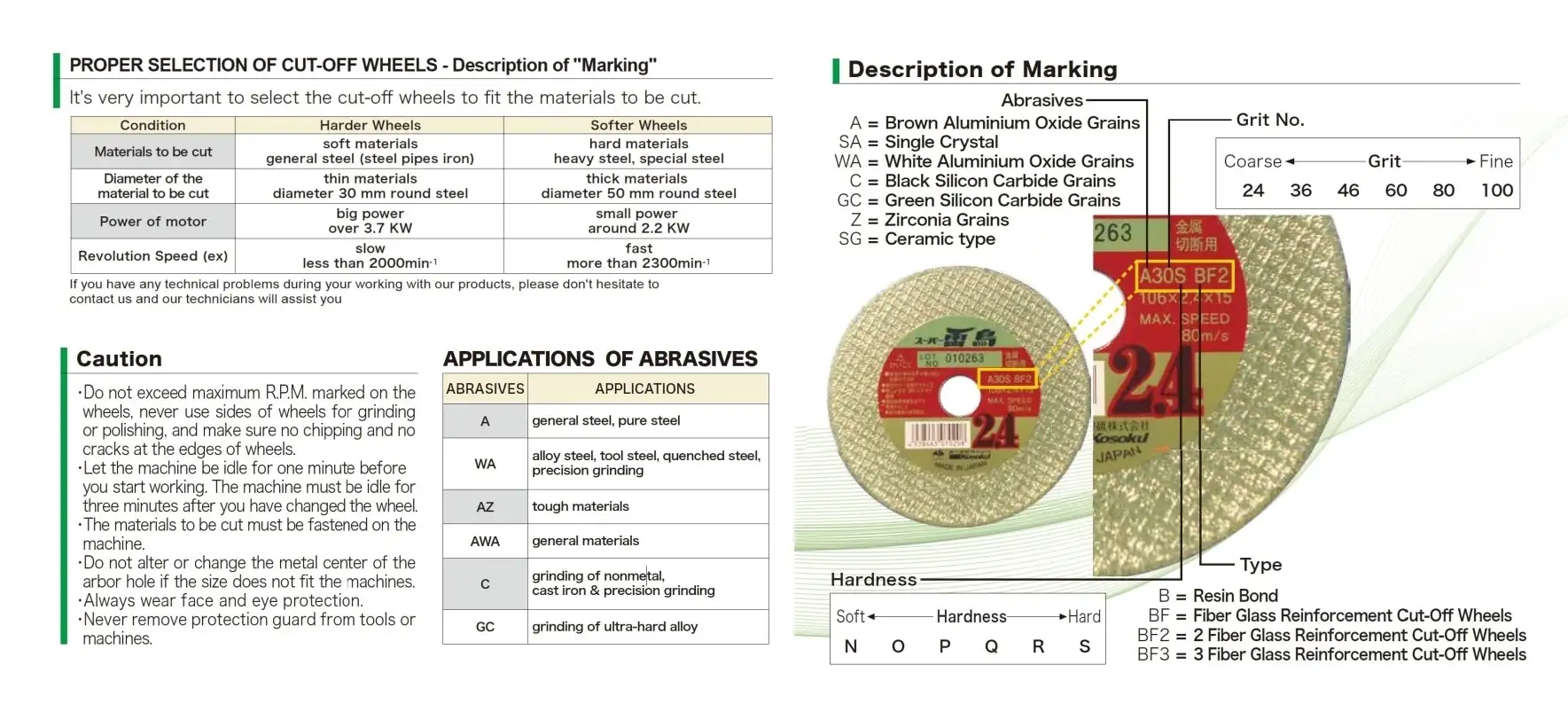
Global Maintenance Standard: To maintain the high safety factor of Fuji wheels, avoid exposure to excessive humidity and chemical solvents during storage. Proper care preserves the resinoid bond's strength, crucial for high-load industrial applications.
Fuji products are manufactured following strict Japanese standard process requirements. Every wheel is engineered to meet or exceed JIS (Japanese Industrial Standards), such as JIS R 6242 and B 4051. Our core engineering logic prioritizes maximum operator protection by maintaining safety factors and burst speed capabilities that often surpass the highest industry benchmarks.
| Standard Region | Safety Factor (Burst Multiplier) | Safety Logic & Benchmark |
|---|---|---|
| FUJI (High Precision) | > 2.0x | Engineered to exceed JIS requirements for maximum reliability. |
| Japan (JIS R 6242) | 2.0x | Extreme Safety: A wheel rated at 80m/s must withstand a 160m/s burst test. |
| Europe (EN 12413) | 1.73x | Risk Balanced: Provides high safety redundancy for most industrial apps. |
| USA (ANSI B7.1) | 1.5x | Efficiency Focused: Relies on machine guarding and operational procedures. |
Abrasive Selection Guide
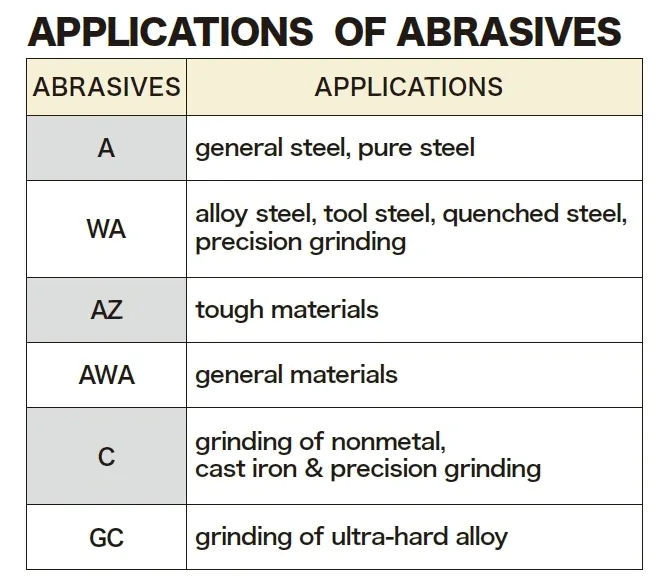
Selection of grains (A, WA, AZ, etc.) based on material hardness and grinding precision.
Warning Symbol Interpretation
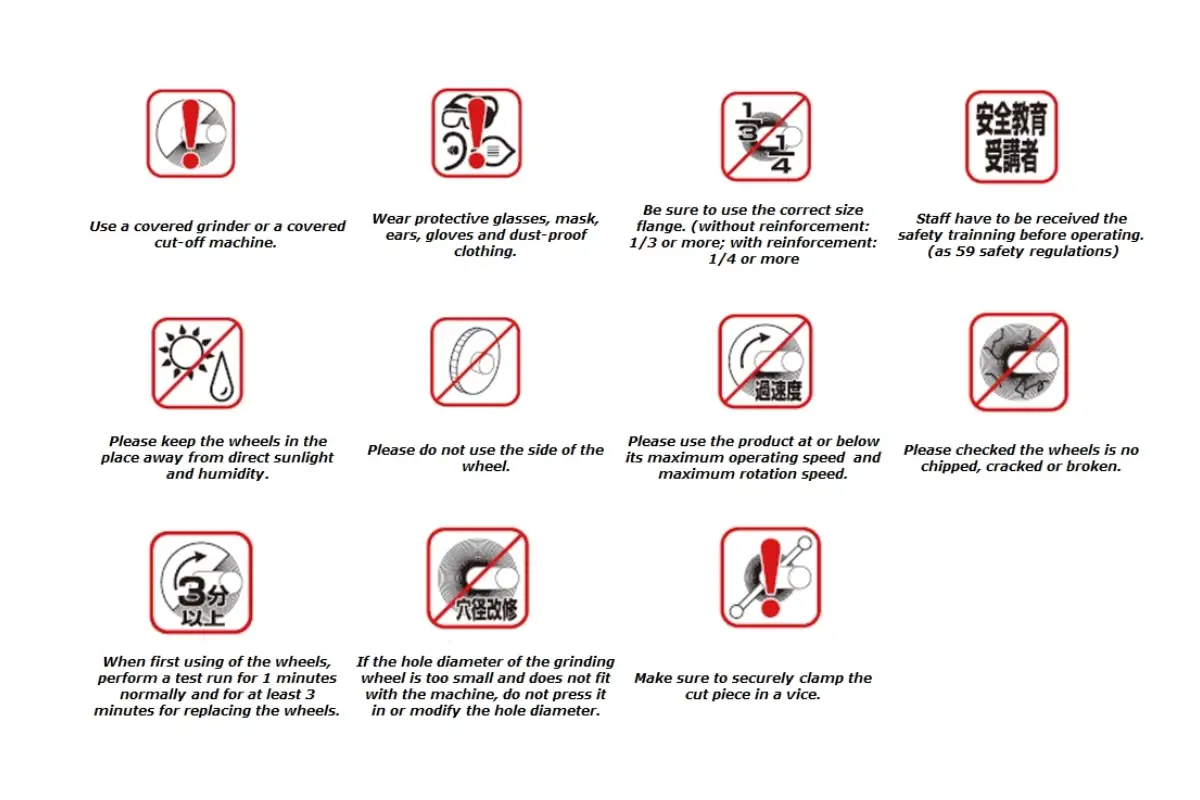
Standardized safety icons for safe operation and protection guard usage.
When deploying Fuji high-performance tools in overseas markets, ensure that the regional power grid frequency and voltage match the tool specifications. To maintain the superior burst speed safety of Fuji wheels, store abrasives in a dry, temperate environment. Humidity can degrade the resin bond, potentially lowering the wheel’s resistance to centrifugal forces.
Fuji products are manufactured following strict Japanese standard process requirements. Every wheel is engineered to meet or exceed JIS (Japanese Industrial Standards), such as JIS R 6242 and B 4051. Our core engineering logic prioritizes maximum operator protection by maintaining safety factors and burst speed capabilities that often surpass the highest industry benchmarks.
| Standard Region | Safety Factor (Burst Multiplier) | Safety Logic & Benchmark |
|---|---|---|
| FUJI (High Precision) | > 2.0x | Engineered to exceed JIS requirements for maximum reliability. |
| Japan (JIS R 6242) | 2.0x | Extreme Safety: A wheel rated at 80m/s must withstand a 160m/s burst test. |
| Europe (EN 12413) | 1.73x | Risk Balanced: Provides high safety redundancy for most industrial apps. |
| USA (ANSI B7.1) | 1.5x | Efficiency Focused: Relies on machine guarding and operational procedures. |
Abrasive Selection Guide
Selection of grains (A, WA, AZ, etc.) based on material hardness and grinding precision.
Warning Symbol Interpretation
Standardized safety icons for safe operation and protection guard usage.
When deploying Fuji high-performance tools in overseas markets, ensure that the regional power grid frequency and voltage match the tool specifications. To maintain the superior burst speed safety of Fuji wheels, store abrasives in a dry, temperate environment. Humidity can degrade the resin bond, potentially lowering the wheel’s resistance to centrifugal forces.


