


FUJI Tsubaki cermet tipped saw blades for steel and stainless-steel profiles, pipes and other catalog-listed applications.


FUJI Tsubaki is a range of cermet tipped circular saw blades for cutting metal pipes and profiles on compatible metal-cutting saws. Choose the blade by machine approval, diameter, bore, speed and workpiece material. The six models cover diameters from 110 to 355 mm; they are not interchangeable simply because they fit the arbor.

Grooves in the blade body reduce contact with the workpiece, helping to reduce frictional heat and load on the tips while improving chip evacuation. Laser-cut slits filled with special resin damp vibration and reduce cutting noise. This is a noise-reduction feature, not silent operation or a substitute for hearing protection.
Compared with abrasive cut-off wheels, which remove material with abrasive grains, cermet teeth cut chips from the workpiece. Cut finish and burr formation depend on material, wall thickness, clamping, feed and blade condition. Check the resulting edge against the requirements of the next operation.

FUJI Seito reports a durability improvement of 30% or more compared with its conventional product. The catalog graph for the 180TU shows 1,080 cuts versus 700 for the comparison blade, cutting SS400 angle, 50 × 50 × 6 mm, on a Makita LC0700F. These are manufacturer test results; working conditions and material affect actual cutting life.

| Model | Diameter (mm) | Kerf (mm) | Bore (mm) | Teeth | Maximum rpm |
|---|---|---|---|---|---|
| 110TU | 110 | 1.4 | 20 | 24 | 4,000 |
| 135TU | 135 | 1.4 | 20 | 30 | 3,500 |
| 165TU | 165 | 1.6 | 22 | 40 | 8,500 |
| 180TU | 180 | 1.7 | 20 | 40 | 4,300 |
| 305TU | 305 | 2.2 | 25.4 | 56 | 1,600 |
| 355TU | 355 | 2.4 | 25.4 | 64 | 1,600 |
The figures above are maximum permitted blade speeds, not recommended cutting speeds for every material. The 305TU and 355TU are listed for low-speed use. Never exceed the blade marking, and follow the saw manufacturer's approved blade specification. Do not fit a toothed blade to an abrasive saw unless that exact use is explicitly approved by the machine manufacturer.
The catalog lists iron and stainless steel, angle and channel sections, electrical conduit, round and square pipe, metal siding, deck plate, lined steel pipe and aluminium sash. Confirm the exact alloy, section and wall thickness when selecting a blade; this list does not establish unlimited cutting capacity.
For a 165 mm alternative, compare the bore and speed ratings of the Sakura 165KT and Super Sakura 165KA. A similar diameter does not establish machine compatibility.
Yes, stainless steel is among the manufacturer's listed applications. Share the grade, profile dimensions, machine model and production requirement so the blade selection can be checked for your operation.
Only where the machine manufacturer approves the toothed blade, its dimensions and speed range. Matching bore diameter alone is insufficient. Guarding, flanges, workholding and the machine's intended use must also be suitable.
Provide the Tsubaki model, quantity, saw make and model, no-load speed, bore size, material grade and section dimensions. Specify the required cut quality and approximate daily workload.
Inspect the blade and tips before mounting, isolate the machine before changing blades, use the specified guards and flanges, and securely clamp and support the workpiece. Follow both blade and machine instructions for feed and protective equipment. Stop using a damaged blade or one that develops abnormal vibration.
Ask FUJI for a machine-specific blade recommendation or view our cut-off wheels and saw blades.
Technical reference: FUJI Seito general catalog, page 44. Confirm the marking and instructions supplied with the actual blade before use.
Choosing the correct abrasive wheel is critical for both operational efficiency and JIS-compliant safety. Fuji Grinding Wheels are engineered with precise technical markings to ensure the perfect match for your specific material and machine requirements.
For professional export markets, always verify the Peripheral Speed (m/s) compatibility. Fuji wheels are designed to exceed JIS Burst Speed factors, but operating at the recommended R.P.M. ensures the longest tool life and cleanest cut.
Note: Mismatched grit or hardness can lead to excessive heat buildup, affecting the workpiece's structural integrity.
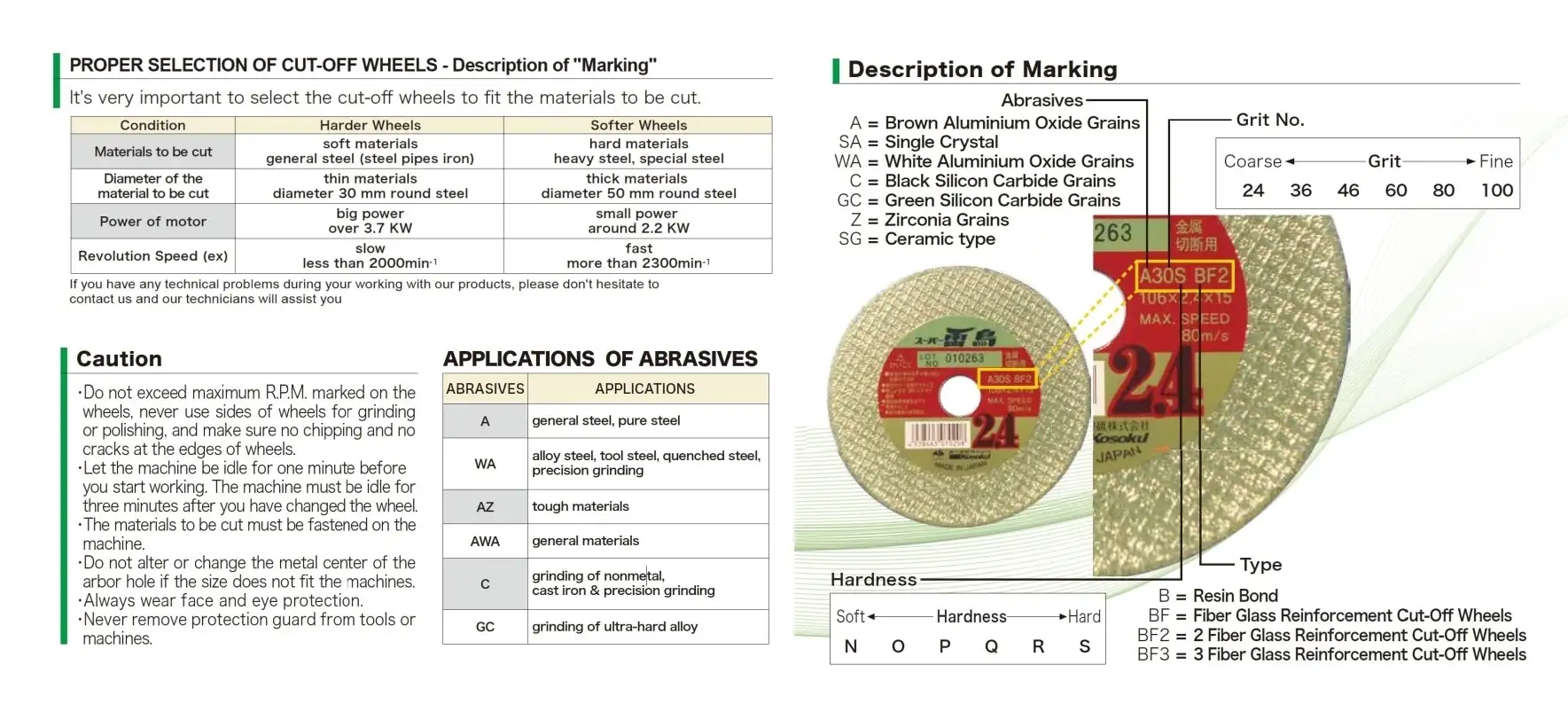
Global Maintenance Standard: To maintain the high safety factor of Fuji wheels, avoid exposure to excessive humidity and chemical solvents during storage. Proper care preserves the resinoid bond's strength, crucial for high-load industrial applications.
Fuji products are manufactured following strict Japanese standard process requirements. Every wheel is engineered to meet or exceed JIS (Japanese Industrial Standards), such as JIS R 6242 and B 4051. Our core engineering logic prioritizes maximum operator protection by maintaining safety factors and burst speed capabilities that often surpass the highest industry benchmarks.
| Standard Region | Safety Factor (Burst Multiplier) | Safety Logic & Benchmark |
|---|---|---|
| FUJI (High Precision) | > 2.0x | Engineered to exceed JIS requirements for maximum reliability. |
| Japan (JIS R 6242) | 2.0x | Extreme Safety: A wheel rated at 80m/s must withstand a 160m/s burst test. |
| Europe (EN 12413) | 1.73x | Risk Balanced: Provides high safety redundancy for most industrial apps. |
| USA (ANSI B7.1) | 1.5x | Efficiency Focused: Relies on machine guarding and operational procedures. |
Abrasive Selection Guide
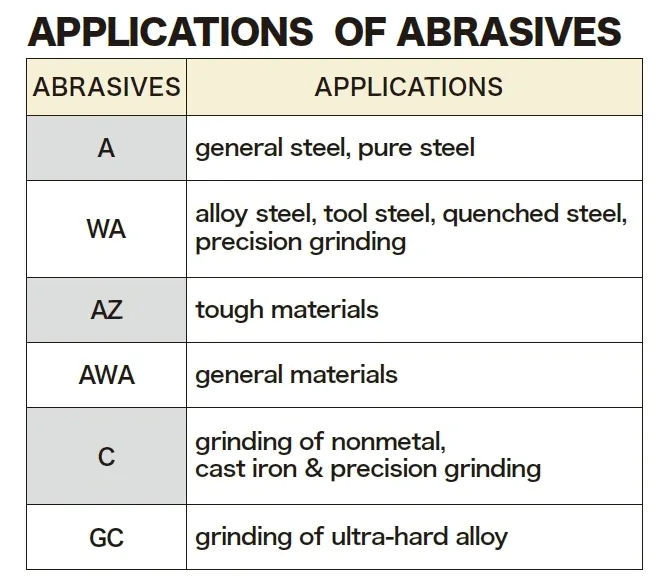
Selection of grains (A, WA, AZ, etc.) based on material hardness and grinding precision.
Warning Symbol Interpretation
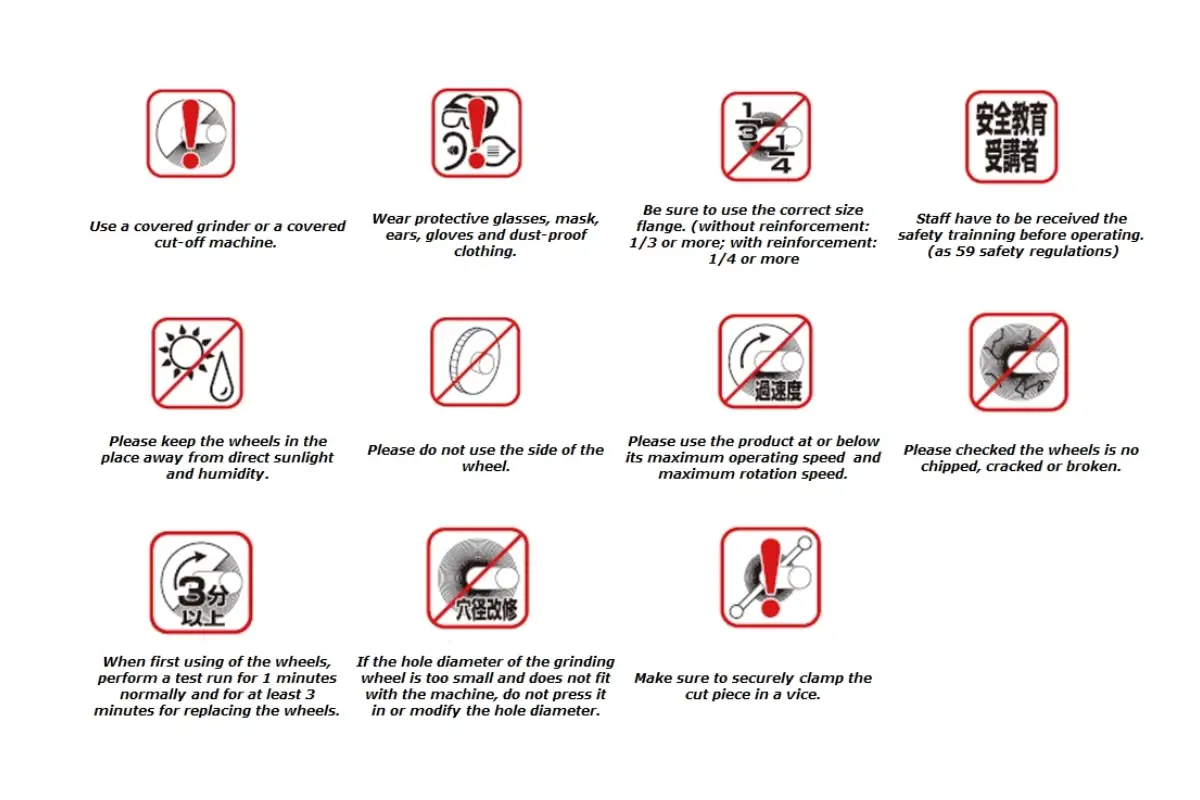
Standardized safety icons for safe operation and protection guard usage.
When deploying Fuji high-performance tools in overseas markets, ensure that the regional power grid frequency and voltage match the tool specifications. To maintain the superior burst speed safety of Fuji wheels, store abrasives in a dry, temperate environment. Humidity can degrade the resin bond, potentially lowering the wheel’s resistance to centrifugal forces.
Fuji products are manufactured following strict Japanese standard process requirements. Every wheel is engineered to meet or exceed JIS (Japanese Industrial Standards), such as JIS R 6242 and B 4051. Our core engineering logic prioritizes maximum operator protection by maintaining safety factors and burst speed capabilities that often surpass the highest industry benchmarks.
| Standard Region | Safety Factor (Burst Multiplier) | Safety Logic & Benchmark |
|---|---|---|
| FUJI (High Precision) | > 2.0x | Engineered to exceed JIS requirements for maximum reliability. |
| Japan (JIS R 6242) | 2.0x | Extreme Safety: A wheel rated at 80m/s must withstand a 160m/s burst test. |
| Europe (EN 12413) | 1.73x | Risk Balanced: Provides high safety redundancy for most industrial apps. |
| USA (ANSI B7.1) | 1.5x | Efficiency Focused: Relies on machine guarding and operational procedures. |
Abrasive Selection Guide
Selection of grains (A, WA, AZ, etc.) based on material hardness and grinding precision.
Warning Symbol Interpretation
Standardized safety icons for safe operation and protection guard usage.
When deploying Fuji high-performance tools in overseas markets, ensure that the regional power grid frequency and voltage match the tool specifications. To maintain the superior burst speed safety of Fuji wheels, store abrasives in a dry, temperate environment. Humidity can degrade the resin bond, potentially lowering the wheel’s resistance to centrifugal forces.


