


Related PA/HZ catalogue grades are distinct specifications. Contact FUJI for the correct version, samples and a quotation.


FUJI Resinox ZA is a 7-inch resin-bonded zirconia grinding wheel for cast iron fettling and casting surface cleanup. It is an option for foundries seeking more productive grinding of grey cast iron, including automotive castings and other iron components. Select the grade for the casting, stock-removal task and available grinder.

This is a grinding wheel, not a thin cut-off disc. Suitability for ductile iron, cast steel, stainless steel or other alloys should be confirmed separately. Small holes and internal cavities may require a different tool and abrasive.
The zirconia abrasive specification is selected for efficient cast iron stock removal. Abrasive choice, bond grade, machine power and contact conditions work together; the abrasive name alone does not establish a fixed wheel-life advantage.
Compare material removed per minute, wheel consumption, changeovers and the accepted surface result against the current wheel. The objective is a lower cost per completed casting. Productivity gains depend on the actual casting and operating conditions; no universal two- or three-times life claim is made here.
The FUJI HGC-3902 7-inch 300Hz high-frequency angle grinder is the recommended machine to discuss for this casting-grinding application. A correctly matched high-frequency tool and abrasive can support productive load grinding and consistent material removal.
Compatibility must be confirmed for the supplied versions. Check wheel diameter, thickness, actual bore, flange, guard and the grinder’s maximum spindle speed against the wheel label. Japan domestic wheels are supplied at 72m/s maximum peripheral speed; European export wheels are supplied at 80m/s. Select the appropriate market version and do not substitute a 72m/s wheel for an 80m/s requirement. Request confirmation of the wheel’s marked maximum RPM and the specific HGC-3902 configuration before use.
The HGC-3902 requires its specified high-frequency supply. Confirm voltage, frequency, connections and machine instructions; a 300Hz tool is not interchangeable with a 250Hz or 400Hz system. For the application context, see automotive casting fettling with FUJI 300Hz equipment.
Japan domestic supply: 72m/s. European export supply: 80m/s. These are maximum peripheral-speed ratings, not spindle RPM. Confirm the market version on the order and check the delivered wheel label. The retained catalogue images below show the Japanese domestic 72m/s specifications; they do not represent the export speed rating.
The original Japanese domestic specification images list the following variants. ZA is the zirconia selection featured on this page. PA and HZ remain listed as related catalogue grades; they should not be treated as identical zirconia formulations or automatically substituted.
| Catalogue grade | Dimensions (mm) | Pack quantity | Marked peripheral speed |
|---|---|---|---|
| ZA24P BF | 180 × 6 × 22 | 50 (10 × 5) | 72m/s |
| ZA24M BF | 180 × 6 × 22 | 50 (10 × 5) | 72m/s |
| PA24M BF — related grade | 180 × 6 × 22 | 60 (20 × 3) | 72m/s |
| HZ24L BF — related grade | 180 × 6 × 22 | 50 (25 × 2) | 72m/s |
The Japanese catalogue also displays approximately 4,300m/min for its 72m/s version. The European export rating of 80m/s corresponds to 4,800m/min. These values describe peripheral speed, not RPM. Use the maximum RPM printed on the delivered wheel. Confirm the exact bore; 22mm and 22.23mm must not be presented as automatically interchangeable.
Type: Resinox ZA (Carton & Specs)


Type: Resinox PA & HZ24L (Carton & Specs)


Send FUJI the iron grade, part photograph, area to be ground, stock-removal requirement, current wheel and grinder details. The ZA24P BF and ZA24M BF references identify different grades; choose between them using an application recommendation and a representative trial.
Before mounting, inspect the wheel’s appearance, label, visible damage and condition. Check the approved machine, flanges and guard, follow the manufacturer’s mounting instructions and use the required protective equipment and dust controls. Do not use damaged wheels or force a mismatched bore. Store resin-bonded wheels dry and protected.
Yes. The zirconia ZA selection is offered for grey cast iron grinding, casting fettling and surface cleanup. Confirm the grade for the particular casting and task.
Discuss it as a matched 180mm foundry-grinding combination. Fitment requires confirmation of wheel dimensions, mounting and marked maximum RPM against the exact machine version; diameter alone is insufficient.
No. They are distinct catalogue grades. This page focuses on zirconia ZA for cast iron; request the specification before selecting a related grade.
There is no fixed gain for every casting. Compare removal rate, wheel consumption and finished quality in a controlled application trial.
Provide your casting material, grinder nameplate details, current wheel, desired dimensions and monthly usage. Contact FUJI for grade selection, HGC-3902 compatibility, samples and a quotation.
Choosing the correct abrasive wheel is critical for both operational efficiency and JIS-compliant safety. Fuji Grinding Wheels are engineered with precise technical markings to ensure the perfect match for your specific material and machine requirements.
For professional export markets, always verify the Peripheral Speed (m/s) compatibility. Fuji wheels are designed to exceed JIS Burst Speed factors, but operating at the recommended R.P.M. ensures the longest tool life and cleanest cut.
Note: Mismatched grit or hardness can lead to excessive heat buildup, affecting the workpiece's structural integrity.
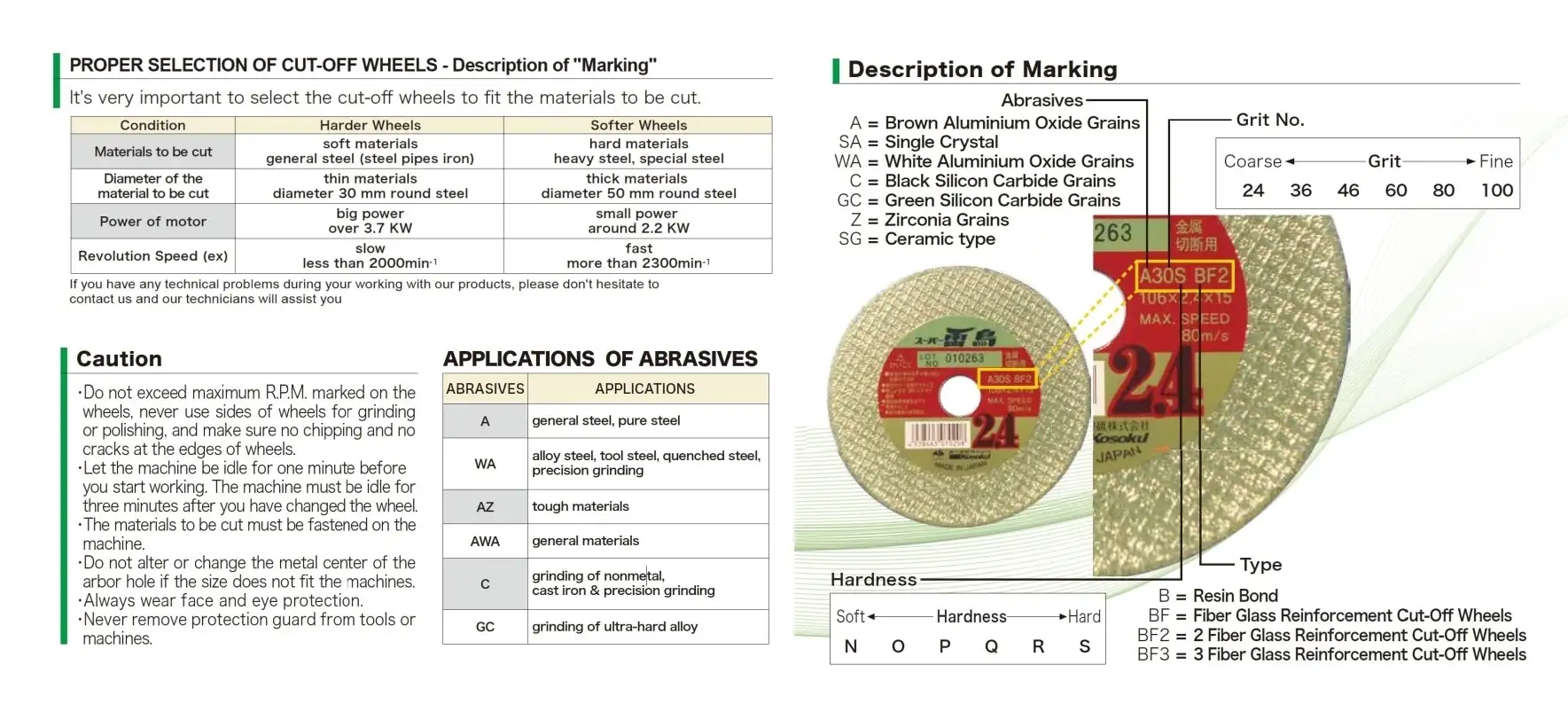
Global Maintenance Standard: To maintain the high safety factor of Fuji wheels, avoid exposure to excessive humidity and chemical solvents during storage. Proper care preserves the resinoid bond's strength, crucial for high-load industrial applications.
Fuji products are manufactured following strict Japanese standard process requirements. Every wheel is engineered to meet or exceed JIS (Japanese Industrial Standards), such as JIS R 6242 and B 4051. Our core engineering logic prioritizes maximum operator protection by maintaining safety factors and burst speed capabilities that often surpass the highest industry benchmarks.
| Standard Region | Safety Factor (Burst Multiplier) | Safety Logic & Benchmark |
|---|---|---|
| FUJI (High Precision) | > 2.0x | Engineered to exceed JIS requirements for maximum reliability. |
| Japan (JIS R 6242) | 2.0x | Extreme Safety: A wheel rated at 80m/s must withstand a 160m/s burst test. |
| Europe (EN 12413) | 1.73x | Risk Balanced: Provides high safety redundancy for most industrial apps. |
| USA (ANSI B7.1) | 1.5x | Efficiency Focused: Relies on machine guarding and operational procedures. |
Abrasive Selection Guide
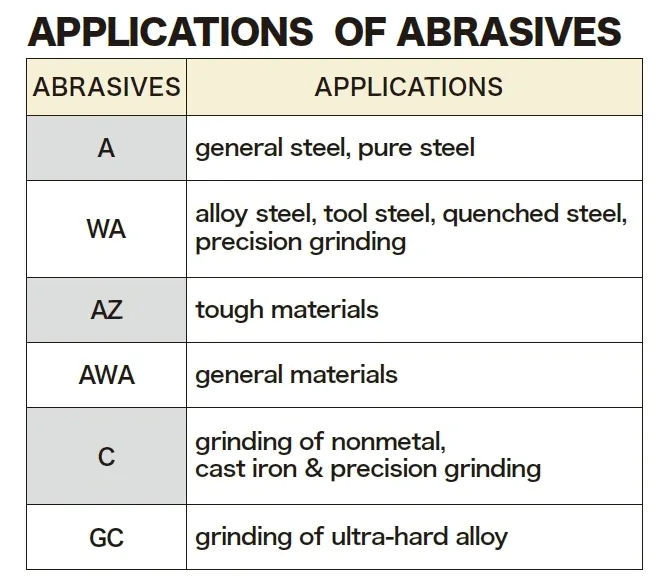
Selection of grains (A, WA, AZ, etc.) based on material hardness and grinding precision.
Warning Symbol Interpretation
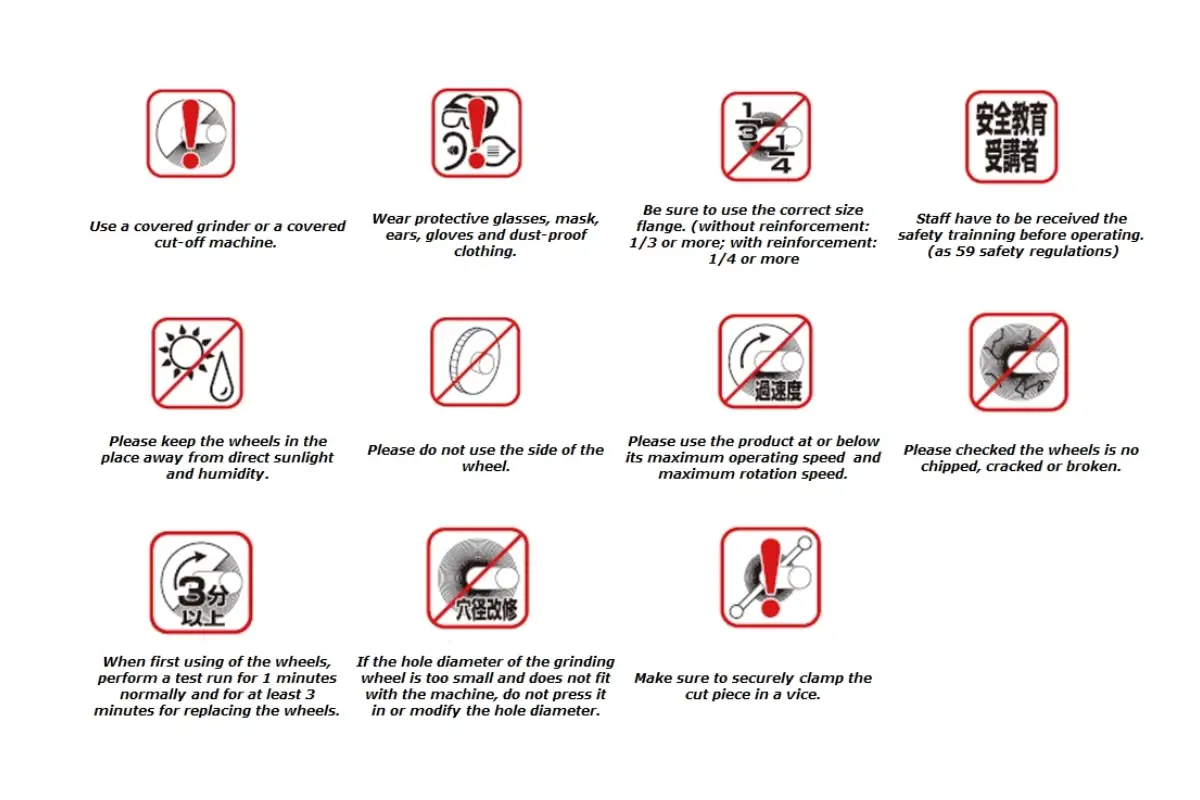
Standardized safety icons for safe operation and protection guard usage.
When deploying Fuji high-performance tools in overseas markets, ensure that the regional power grid frequency and voltage match the tool specifications. To maintain the superior burst speed safety of Fuji wheels, store abrasives in a dry, temperate environment. Humidity can degrade the resin bond, potentially lowering the wheel’s resistance to centrifugal forces.
Fuji products are manufactured following strict Japanese standard process requirements. Every wheel is engineered to meet or exceed JIS (Japanese Industrial Standards), such as JIS R 6242 and B 4051. Our core engineering logic prioritizes maximum operator protection by maintaining safety factors and burst speed capabilities that often surpass the highest industry benchmarks.
| Standard Region | Safety Factor (Burst Multiplier) | Safety Logic & Benchmark |
|---|---|---|
| FUJI (High Precision) | > 2.0x | Engineered to exceed JIS requirements for maximum reliability. |
| Japan (JIS R 6242) | 2.0x | Extreme Safety: A wheel rated at 80m/s must withstand a 160m/s burst test. |
| Europe (EN 12413) | 1.73x | Risk Balanced: Provides high safety redundancy for most industrial apps. |
| USA (ANSI B7.1) | 1.5x | Efficiency Focused: Relies on machine guarding and operational procedures. |
Abrasive Selection Guide
Selection of grains (A, WA, AZ, etc.) based on material hardness and grinding precision.
Warning Symbol Interpretation
Standardized safety icons for safe operation and protection guard usage.
When deploying Fuji high-performance tools in overseas markets, ensure that the regional power grid frequency and voltage match the tool specifications. To maintain the superior burst speed safety of Fuji wheels, store abrasives in a dry, temperate environment. Humidity can degrade the resin bond, potentially lowering the wheel’s resistance to centrifugal forces.


