


FUJI KOSOKU replacement band saw blades: SK for general steel, bi-metal for stainless steel, and machine-specific portable or stationary ranges. Choose by material, blade dimensions and tooth pitch.


Select the blade by material, machine and workpiece section. The catalogue distinguishes SK blades for general steel, bi-metal blades for stainless steel, M42 combination blades and F-B portable or stationary machine ranges. Specifications vary across these families.
The illustrated bi-metal construction combines a high-speed-steel cutting edge with a special-steel backing. The SL tooth arrangement uses repeating pitch variations to help reduce vibration and cutting noise. Actual blade life and cut quality depend on the workpiece, feed, speed, tension and setup; a universal percentage improvement is not specified.
| Blade range | Listed dimensions | Selection |
|---|---|---|
| SK for general steel | 13 mm width; length and thickness by machine | 14, 18 or 24 TPI, depending on listed size |
| Bi-metal for stainless steel | 1130 / 1140 / 1250 / 1440 × 13 × 0.65 mm | 18 TPI in the illustrated range |
| M42 combination blade | 2750 / 3000 × 27 × 0.9 mm | 4/6, 5/8, 6/10 or 8/12 TPI |
| F-B portable and stationary ranges | Machine-specific lengths, widths and thicknesses | Confirm the catalogue row and required pitch |
Confirm the exact length, width, thickness and tooth pitch before ordering. A blade is not compatible solely because its length matches. The catalogue lists different blade families and machine combinations; do not substitute their dimensions without checking the saw requirements.
The HRB-1140·SC portable band saw uses 1140 mm blades. Its catalogue lists 14, 18 and 24 TPI for general steel and 18 TPI for stainless or special steel with the appropriate bi-metal blade. The saw is shown with one 1140 mm, 18 TPI general-steel blade as an accessory; replacement-blade packaging depends on the selected blade range.
For pipes and sections, select pitch according to the wall thickness and tooth engagement. For solid stock, consider the section and chip clearance. Follow the saw and blade instructions for speed, feed, tension, break-in and lubrication.
FUJI Rotor Band Saw application demonstration
Select an image to view the full-size catalogue.


Specify the stainless grade and section, and choose the appropriate bi-metal blade. Do not assume a general-steel SK blade and a stainless-steel blade are interchangeable.
The catalogue includes machine-specific F-B sizes. Provide the saw model and required blade length, width, thickness and pitch so the correct catalogue option can be checked.
Send the machine model, current blade label, material, workpiece dimensions, desired pitch and quantity. Confirm the exact specification and pack quantity in the quotation.
Fuji products are manufactured following strict Japanese standard process requirements. Every wheel is engineered to meet or exceed JIS (Japanese Industrial Standards), such as JIS R 6242 and B 4051. Our core engineering logic prioritizes maximum operator protection by maintaining safety factors and burst speed capabilities that often surpass the highest industry benchmarks.
| Standard Region | Safety Factor (Burst Multiplier) | Safety Logic & Benchmark |
|---|---|---|
| FUJI (High Precision) | > 2.0x | Engineered to exceed JIS requirements for maximum reliability. |
| Japan (JIS R 6242) | 2.0x | Extreme Safety: A wheel rated at 80m/s must withstand a 160m/s burst test. |
| Europe (EN 12413) | 1.73x | Risk Balanced: Provides high safety redundancy for most industrial apps. |
| USA (ANSI B7.1) | 1.5x | Efficiency Focused: Relies on machine guarding and operational procedures. |
Abrasive Selection Guide
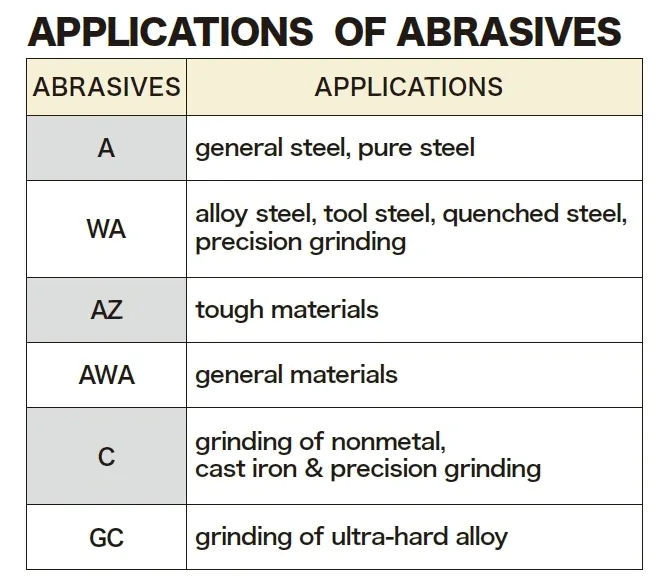
Selection of grains (A, WA, AZ, etc.) based on material hardness and grinding precision.
Warning Symbol Interpretation
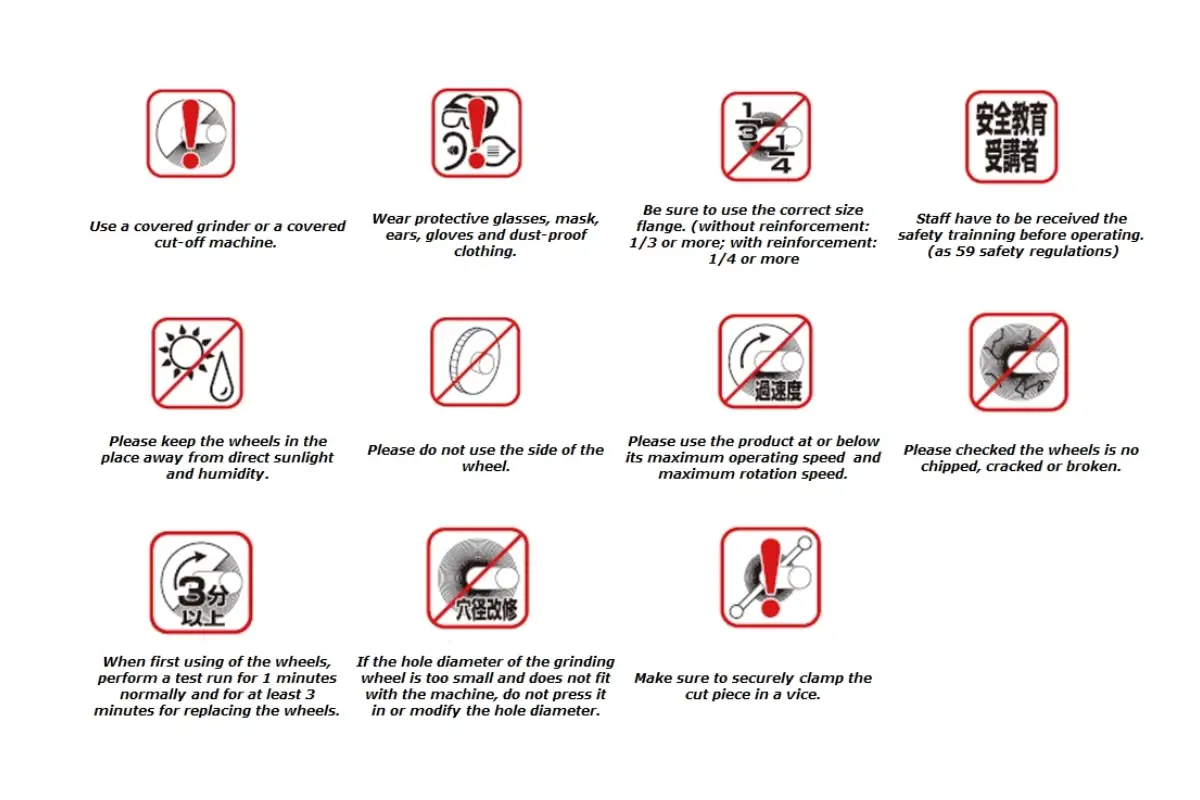
Standardized safety icons for safe operation and protection guard usage.
When deploying Fuji high-performance tools in overseas markets, ensure that the regional power grid frequency and voltage match the tool specifications. To maintain the superior burst speed safety of Fuji wheels, store abrasives in a dry, temperate environment. Humidity can degrade the resin bond, potentially lowering the wheel’s resistance to centrifugal forces.
Fuji products are manufactured following strict Japanese standard process requirements. Every wheel is engineered to meet or exceed JIS (Japanese Industrial Standards), such as JIS R 6242 and B 4051. Our core engineering logic prioritizes maximum operator protection by maintaining safety factors and burst speed capabilities that often surpass the highest industry benchmarks.
| Standard Region | Safety Factor (Burst Multiplier) | Safety Logic & Benchmark |
|---|---|---|
| FUJI (High Precision) | > 2.0x | Engineered to exceed JIS requirements for maximum reliability. |
| Japan (JIS R 6242) | 2.0x | Extreme Safety: A wheel rated at 80m/s must withstand a 160m/s burst test. |
| Europe (EN 12413) | 1.73x | Risk Balanced: Provides high safety redundancy for most industrial apps. |
| USA (ANSI B7.1) | 1.5x | Efficiency Focused: Relies on machine guarding and operational procedures. |
Abrasive Selection Guide
Selection of grains (A, WA, AZ, etc.) based on material hardness and grinding precision.
Warning Symbol Interpretation
Standardized safety icons for safe operation and protection guard usage.
When deploying Fuji high-performance tools in overseas markets, ensure that the regional power grid frequency and voltage match the tool specifications. To maintain the superior burst speed safety of Fuji wheels, store abrasives in a dry, temperate environment. Humidity can degrade the resin bond, potentially lowering the wheel’s resistance to centrifugal forces.


