Constant Speed, Maximum Productivity

FUJI “KOSOKU” High-Freq Unstoppable Power
  • FUJI High Frequency Grinding System
  • Grinding work of HGP-4260 Grinder
  •  180mm High Frequency Grinder (HGP-4260)
  • High Frequency Grinder (HGP-4260) Size
  • FUJI HIGH frequency 250hz power generator
  • FUJI High-Frequency Angle Grinder with specialized grinding wheel performing heavy-duty weld removal on steel plates in Foundry
  • High Frequency Grinder (HGP-4260) Power Cord
  • high frequency grinder accessories
  • FUJI High-Frequency Grinder with specialized wheel removing casting imperfections in a foundry environment with sparks
  • Power Curve Comparison

FUJI 400Hz 180mm High-Frequency Grinders | HGP-4160 & HGP-4260

No.HF Power Tools from Fuji

FUJI 400Hz 180mm / 7-Inch Grinding Systems

Compare two compact KOSOKU high-frequency grinders for mobile workstations:

  • HGP-4160: 2.7kg, 1,600W, 6.5A; light- and medium-duty grinding.
  • HGP-4260: 3.5kg, 2,600W, 9.5A; short periods of heavy grinding.
  • Required supply: compatible electronic HFD inverter supplying three-phase 200V at 400Hz, with a dedicated output cable.
  • Handling: compact pot-type layout, anti-vibration auxiliary handle; soft start and braking through the dedicated power supply.
  • Matching abrasives: approved 180mm high-speed grinding wheels, including suitable Super F2 versions.

Separate systems: these models cannot connect directly to ordinary mains or 250Hz / 300Hz high-frequency supplies. Avoid prolonged overload; compare the separate 300Hz heavy-grinding and 250Hz Japanese-system ranges for other duty requirements.

  • FUJI High Frequency Grinding System
  • Grinding work of HGP-4260 Grinder
  •  180mm High Frequency Grinder (HGP-4260)
  • High Frequency Grinder (HGP-4260) Size
  • FUJI HIGH frequency 250hz power generator
  • FUJI High-Frequency Angle Grinder with specialized grinding wheel performing heavy-duty weld removal on steel plates in Foundry
  • High Frequency Grinder (HGP-4260) Power Cord
  • high frequency grinder accessories
  • FUJI High-Frequency Grinder with specialized wheel removing casting imperfections in a foundry environment with sparks
  • Power Curve Comparison
  • Description

  • Cautions

  • Electrical Symbol

FUJI HGP-4160 & HGP-4260: 400Hz High-Frequency Angle Grinders

For efficient grinding at mobile workstations, FUJI offers two 180mm high-frequency angle grinders: the 2.7kg HGP-4160 for light- and medium-duty grinding and the HGP-4260 for short periods of heavy grinding. Both operate on three-phase 200V at 400Hz and require a compatible FUJI electronic Variable Frequency Drive (VFD).

These grinders cannot be used directly on ordinary 50/60Hz mains or on a 250Hz or 300Hz generator. Select the complete grinder, converter and dedicated cable configuration before ordering.

FUJI High-Frequency Grinder removing casting imperfections in a foundry

Choose the Model for Your Grinding Work

HGP-4160 combines 1600W input power with a 2.7kg tool weight for light- and medium-duty work where handling weight matters. HGP-4260 provides 2600W input power at 3.5kg for short heavy-grinding tasks at changing workstations. Both use an 180mm wheel and have a rated speed of 8000 rpm. Input power is electrical consumption, not mechanical output power.

Grinding work of HGP-4260 Grinder

HGP-4160 and HGP-4260 Specifications

FUJI 400Hz angle grinder model comparison
Parameter HGP-4160 HGP-4260
Intended use Light- and medium-duty grinding Short-duration heavy grinding
Power consumption (input) 1600W 2600W
Rated current 6.5A 9.5A
Tool weight 2.7kg 3.5kg
Rated speed 8000 rpm 8000 rpm
Tool supply Three-phase 200V, 400Hz Three-phase 200V, 400Hz
Grinding wheel (diameter × thickness × bore) 180 × 5–8 × 22.23mm 180 × 5–8 × 22.23mm
Required power source Compatible FUJI electronic VFD Compatible FUJI electronic VFD

Use manufacturer-approved grinding wheels with an 80m/s rating. At 180mm diameter and 8000 rpm, the calculated rim speed is approximately 75.4m/s; the wheel rating is not the same as its actual operating speed. Confirm wheel type, mounting flanges, guard and permitted working surface. A cut-off wheel must not be used for side grinding.

Required Electronic HFD: Confirm Mains Input, 200V / 400Hz Tool Output

Power path: mains matching the selected drive input rating → compatible FUJI electronic HFD → three-phase 200V, 400Hz output → dedicated cable → HGP-4160 or HGP-4260.

The VFD uses solid-state AC–DC–AC conversion. A rectifier converts incoming AC to DC, the DC link smooths it, and a PWM inverter produces the controlled AC output required by the motor.

See the FUJI FKC-400H high-frequency inverter. Confirm its capacity, approved grinder combination, output connectors and dedicated cable with FUJI. The dedicated cable is sold separately. Do not assume another VFD or an existing 250Hz cable is interchangeable.

Fuji Kosoku high frequency inverter power supply

Electronic VFD and Rotary Generator: Different Systems

Electronic VFDs offer a compact, portable power-conversion option for workstations that move between jobs. Provide the specified ventilation, cooling and protection against dust and moisture. Overload protection may stop operation if the system limits are exceeded; select capacity for the actual duty.

Mechanical rotary converters use a motor-driven generating system and electromagnetic induction to change frequency. Their weight makes frequent relocation less convenient. Appropriately specified rotary systems can suit fixed foundry installations and demanding duty, subject to their rated environmental and overload limits.

Compatibility boundary: FUJI currently offers 250Hz rotary power supplies, with no compatible 400Hz rotary option for these two models. The FUJI 250Hz grinder and rotary-generator combination is a separate system, not an alternative supply for HGP-4160 or HGP-4260. Select equipment by rated voltage, frequency and approved configuration, rather than treating one frequency as universally better.

·400Hz vs European 300Hz vs Japanese 250Hz Systems

System Application focus Power and replacement requirements
400Hz — HGP-4160 / HGP-4260 Mobile workstations, compact handling and efficient local grinding. 4160: light and medium duty; 4260: short heavy-grinding tasks. Compatible electronic HFD supplying three-phase 200V / 400Hz. Not a replacement tool for a 250Hz or 300Hz generator.
300Hz — European-system models Heavy grinding and replacement of aging equipment in suitable existing European high-frequency installations. A correctly specified FUJI 300Hz model can connect to a compatible existing 300Hz supply after voltage, phase, connectors, wiring, capacity and manufacturer approval are verified. Frequency alone does not establish compatibility.
250Hz — Japanese domestic systems Japanese foundry and shipyard installations; the FUJI range includes 5-inch and 7-inch angle-grinder options for different tasks. Consider this range when lighter handling is a priority compared with larger 7-inch and 9-inch 300Hz heavy-grinding models; compare the exact model weights and grip dimensions. Use the approved matching 250Hz high-frequency supply and cable configuration. Traditional installations use rotating motor-generator converters. This is separate from the 400Hz electronic HFD system.

Compare the FUJI 300Hz grinder for compatible European-system replacement, 250Hz 7-inch grinder range and 5-inch high-frequency grinder range. Confirm each model’s exact electrical version before ordering.

For operators in Asian workshops and elsewhere, select by tool weight, grip dimensions, working posture and duty rather than nationality. Evaluate handling with the actual operator and abrasive. Frequency does not by itself determine comfort, efficiency or overload tolerance.

·Mobile Workstations and Overload Limits

The compact pot-type layout places the motor above the wheel. HGP-4160 is 309mm long and 110mm high; HGP-4260 is 309mm long and 125mm high. Their low tool weights support frequent repositioning; the separate drive and cable add to the complete system weight.

The electronic 400Hz system has limited tolerance for impact loads and overload. Avoid sustained excessive pressure and repeated protection resets. Prolonged overload can shorten tool and drive life. Choose a system rated for sustained demanding duty when foundry stock removal is the primary job.

·Choose the Model and Matching Grinding Wheel

HGP-4160: 2.7kg, light- and medium-duty grinding | HGP-4260: 3.5kg, short-duration heavy grinding.

For ordinary steel weld dressing and surface work, consider a compatible Super F2 180mm grinding wheel. Ask about suitable Super Z zirconia wheels where greater stock removal is needed. Use the approved 80m/s version and verify marked RPM, wheel dimensions, flanges and guard.

·Features for Industrial Grinding

The brushless motor construction eliminates carbon-brush replacement. This refers to the motor’s commutation structure; it does not mean spark-free grinding or approval for explosive atmospheres. The auxiliary anti-vibration handle and grip support tool control. Soft start and braking are functions of the dedicated inverter power supply; confirm the supplied converter’s functions.

Grinding output and speed under load depend on the material, abrasive, pressure, supply and duty cycle. Evaluate performance on the actual job rather than assuming a universal productivity multiplier, fixed fatigue reduction or zero speed drop.

Power Reduction Curve: FUJI High Frequency vs Conventional Grinders
Illustrative comparison graphic only; it does not establish a measured speed-retention or productivity guarantee for either model.

Industrial Grinding Demonstration

The video illustrates a particular grinding setup. Results depend on the tested tool, wheel, material and operating conditions.

Applications and Site Requirements

Shipbuilding and ship repair: weld dressing and steel surface preparation with a suitable abrasive.
Mobile heavy-grinding stations: jobs where a portable converter is helpful and the specified three-phase power supply is available.
Railway field weld maintenance: appropriate grinding operations with approved site procedures, compatible power and environmental protection.
Duty limitation: this compact electronic 400Hz system is not recommended for prolonged overload or continuous high-pressure foundry stock removal.

Select abrasives for the workpiece material and task. Observe the tool and abrasive instructions, guards, speed ratings, inspection procedures and site risk controls. Keep converter ventilation clear and follow specified operating and cooling limits.

Frequently Asked Questions

Can HGP-4160 and HGP-4260 connect directly to mains power?

No. Both require a compatible FUJI electronic VFD and dedicated output cable. Confirm the selected drive’s mains input rating separately; its required output to these grinders is three-phase 200V at 400Hz.

Can a FUJI 250Hz rotary generator power these models?

No. HGP-4160 and HGP-4260 are 400Hz models. FUJI currently offers 250Hz rotary supplies, not a compatible 400Hz rotary supply for these grinders.

Which model is intended for heavier grinding?

HGP-4260 is intended for short-duration heavy grinding at mobile workstations, with 2600W input power and a 3.5kg tool weight. HGP-4160 is for light- and medium-duty grinding, with 1600W input power and a lighter 2.7kg tool weight. Both are rated at 8000 rpm.

Which grinding wheels are specified?

The catalog specifies 180mm diameter, 5–8mm thickness and a 22.23mm bore. Select an approved grinding wheel rated for 80m/s and at least the tool speed, with a compatible wheel type, guard and mounting arrangement. Follow the tool and wheel manufacturers’ instructions.

Are the converter and cable included?

Confirm the complete supply scope before ordering. A compatible FUJI VFD is required, and the dedicated output cable is sold separately. Converter capacity, cable length, connectors and the number of connected tools must be confirmed for the selected configuration.

FUJI and KOSOKU Industrial Tool Heritage

FUJI is a well-known Japanese manufacturer of abrasives and power tools. Our sub-brand KOSOKU produced Japan’s first angle grinder, and our history now spans more than 70 years.

Combining abrasive expertise with industrial power-tool experience, FUJI helps customers select matched grinders, wheels and power supplies for demanding foundry and shipyard work. Our technical team can advise on the 400Hz model, dedicated VFD and cable configuration to suit your application.

FUJI High-Frequency Grinder in heavy-duty action

Find the Right FUJI 400Hz Grinding System

Tell us your grinding task and available power supply. We’ll help you select the grinder, compatible FUJI VFD and accessories for your operation.

Contact Our Technical Team

FUJI Industrial Quality & Safety Protocols

Fuji products are manufactured following strict Japanese standard process requirements. Every wheel is engineered to meet or exceed JIS (Japanese Industrial Standards), such as JIS R 6242 and B 4051. Our core engineering logic prioritizes maximum operator protection by maintaining safety factors and burst speed capabilities that often surpass the highest industry benchmarks.

Standard Region Safety Factor (Burst Multiplier) Safety Logic & Benchmark
FUJI (High Precision) > 2.0x Engineered to exceed JIS requirements for maximum reliability.
Japan (JIS R 6242) 2.0x Extreme Safety: A wheel rated at 80m/s must withstand a 160m/s burst test.
Europe (EN 12413) 1.73x Risk Balanced: Provides high safety redundancy for most industrial apps.
USA (ANSI B7.1) 1.5x Efficiency Focused: Relies on machine guarding and operational procedures.

⚠️ Essential Safety Cautions & Operational Integrity

  • 1. RPM Compliance: Never exceed the maximum R.P.M. specified on the wheel. Using the sides of the wheels for grinding is strictly prohibited, as it compromises the structural integrity of the abrasive bond.
  • 2. Mandatory Idling: Allow the tool to idle for one minute before beginning work. If a new wheel has been mounted, an idle run of three minutes is required to ensure dynamic stability.
  • 3. Workpiece Stability: All materials must be securely fastened. Improperly secured workpieces can lead to vibration, wheel binding, and unsafe kickback forces.
  • 4. Arbor Hole Integrity: Do not modify or enlarge the metal center of the arbor hole. A proper fit is critical; a mismatched arbor causes eccentric rotation and dangerous vibration levels.
  • 5. PPE Requirements: Industrial-grade face and eye protection are mandatory at all times. Ensure all protective gear meets local safety compliance standards.
  • 6. Guard Protection: Protection guards are designed to contain fragments in the unlikely event of a wheel failure. Never operate tools or machinery with guards removed.

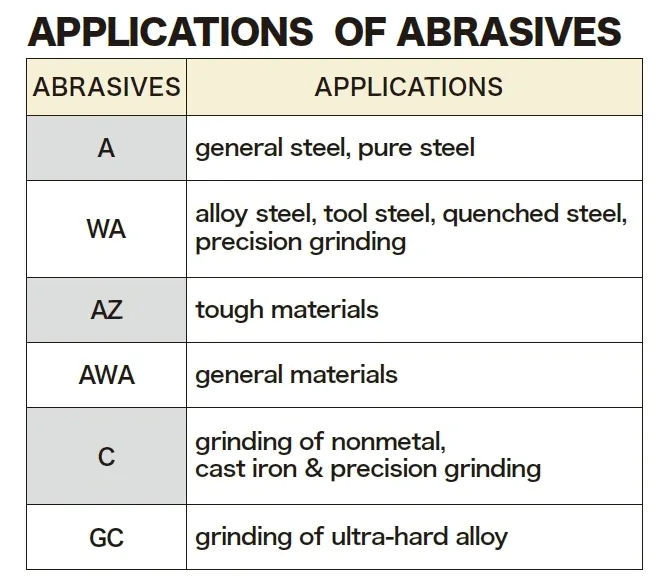
Applications of Abrasives & Usage Notes

Abrasive Selection Guide

FUJI Abrasive Selection Table

Selection of grains (A, WA, AZ, etc.) based on material hardness and grinding precision.

Warning Symbol Interpretation
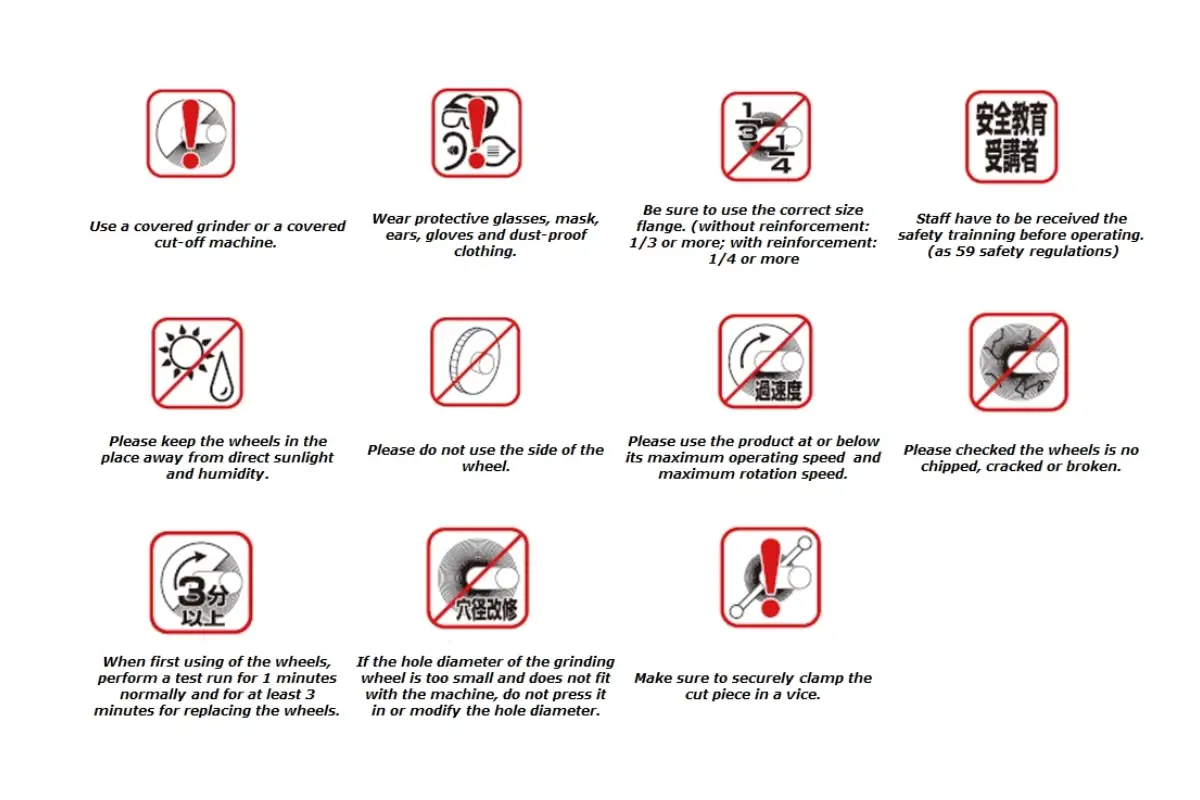
FUJI Usage Symbols and Cautions

Standardized safety icons for safe operation and protection guard usage.

Professional Export & Maintenance Insight

When deploying Fuji high-performance tools in overseas markets, ensure that the regional power grid frequency and voltage match the tool specifications. To maintain the superior burst speed safety of Fuji wheels, store abrasives in a dry, temperate environment. Humidity can degrade the resin bond, potentially lowering the wheel’s resistance to centrifugal forces.

FUJI Industrial Quality & Safety Protocols

Fuji products are manufactured following strict Japanese standard process requirements. Every wheel is engineered to meet or exceed JIS (Japanese Industrial Standards), such as JIS R 6242 and B 4051. Our core engineering logic prioritizes maximum operator protection by maintaining safety factors and burst speed capabilities that often surpass the highest industry benchmarks.

Standard Region Safety Factor (Burst Multiplier) Safety Logic & Benchmark
FUJI (High Precision) > 2.0x Engineered to exceed JIS requirements for maximum reliability.
Japan (JIS R 6242) 2.0x Extreme Safety: A wheel rated at 80m/s must withstand a 160m/s burst test.
Europe (EN 12413) 1.73x Risk Balanced: Provides high safety redundancy for most industrial apps.
USA (ANSI B7.1) 1.5x Efficiency Focused: Relies on machine guarding and operational procedures.

⚠️ Essential Safety Cautions & Operational Integrity

  • 1. RPM Compliance: Never exceed the maximum R.P.M. specified on the wheel. Using the sides of the wheels for grinding is strictly prohibited, as it compromises the structural integrity of the abrasive bond.
  • 2. Mandatory Idling: Allow the tool to idle for one minute before beginning work. If a new wheel has been mounted, an idle run of three minutes is required to ensure dynamic stability.
  • 3. Workpiece Stability: All materials must be securely fastened. Improperly secured workpieces can lead to vibration, wheel binding, and unsafe kickback forces.
  • 4. Arbor Hole Integrity: Do not modify or enlarge the metal center of the arbor hole. A proper fit is critical; a mismatched arbor causes eccentric rotation and dangerous vibration levels.
  • 5. PPE Requirements: Industrial-grade face and eye protection are mandatory at all times. Ensure all protective gear meets local safety compliance standards.
  • 6. Guard Protection: Protection guards are designed to contain fragments in the unlikely event of a wheel failure. Never operate tools or machinery with guards removed.

Applications of Abrasives & Usage Notes

Abrasive Selection Guide

FUJI Abrasive Selection Table

Selection of grains (A, WA, AZ, etc.) based on material hardness and grinding precision.

Warning Symbol Interpretation

FUJI Usage Symbols and Cautions

Standardized safety icons for safe operation and protection guard usage.

Professional Export & Maintenance Insight

When deploying Fuji high-performance tools in overseas markets, ensure that the regional power grid frequency and voltage match the tool specifications. To maintain the superior burst speed safety of Fuji wheels, store abrasives in a dry, temperate environment. Humidity can degrade the resin bond, potentially lowering the wheel’s resistance to centrifugal forces.

🛡️ Electrical Appliance & Safety Compliance

This product strictly complies with the Electrical Appliance and Material Safety Technology Standards (Noise Countermeasures), revised under the Ministry of Economy, Trade and Industry (METI) Ordinance No. 57.

*Official Enforcement Date: April 1, 2013. This ensures maximum electromagnetic compatibility (EMC) and operational stability in industrial environments.

How to Read Operational & Safety Symbols

Fuji Tool Safety Symbols Chart

Key Safety Indicators:

  • Double Insulation: Marked by the "square-in-a-square" symbol, indicating no grounding is required for safe operation.
  • Noise Suppression: Compliance with Ordinance No. 57 prevents interference with other electronic equipment.
  • Mandatory PPE: Visual cues for hearing, eye, and respiratory protection.

Professional Note: For global industrial procurement, these Japanese METI standards ensure that Fuji tools meet high-level noise reduction requirements, critical for precision workshops across Europe and North America.