FUJI KOSOKU HDR Series: Compact Handling. Practical Grinding Power.
100mm (4-inch) corded angle grinders for weld dressing, deburring and metal surface preparation.
Specify your voltage, frequency and plug when ordering. Select accessories to match the supplied machine.


The FUJI KOSOKU HDR-1000R and HDR-1000RL are compact, 100mm (4-inch) corded angle grinders for metal fabrication, deburring and weld dressing. Their compact heads, easy-to-grip housings and 1.6kg catalogue weight make them practical tools for workshop grinding and maintenance. Choose the 12,000 RPM HDR-1000R or the 9,000 RPM HDR-1000RL to suit your abrasive and finishing task.
The standard Japanese domestic specification operates on 100V. FUJI can manufacture a 220V version to order for export. Specify the destination, supply frequency and plug when requesting a quotation. These are separate electrical versions: the 100V machine must not be connected directly to a 220V supply.
FUJI brings together grinding abrasives and KOSOKU power tools for metalworking. Selecting the grinder and wheel as a working combination helps match stock removal, surface finish and operating cost to your job. The HDR series offers a compact Japanese-style grinder format for fabrication shops, maintenance teams and industrial users.

Compact HDR-1000R for workshop metal grinding.
The following ratings describe the Japanese 100V catalogue versions. Electrical ratings for custom 220V production will be confirmed in the export quotation.
| Specification | HDR-1000R | HDR-1000RL |
|---|---|---|
| No-load speed | 12,000 RPM | 9,000 RPM |
| Wheel diameter | 100mm (4 inch) | 100mm (4 inch) |
| Catalogue wheel dimensions | 100 × 6 (4) × 15mm — diameter × thickness × bore | |
| Japanese supply voltage | 100V | 100V |
| Power consumption (100V) | 760W | 670W |
| Current (100V) | 7.8A | 7.0A |
| Catalogue mass | 1.6kg | 1.6kg |
| Power cord | 2.5m | 2.5m |
| Export option | 220V custom production; confirm frequency, plug and supplied configuration | |
Reference: FUJI Seito grinder catalogue. Use the supplied machine's rating plate and manual when selecting the power supply and accessories.
HDR-1000R — 12,000 RPM: The higher-speed option for compatible grinding accessories and general metalworking tasks.
HDR-1000RL — 9,000 RPM: A lower-speed option where the selected abrasive and process call for it. Compare both models on the actual material and finish required, recording grinding time, wheel consumption and surface quality.

Match the wheel diameter, thickness, bore and mounting flanges to the machine. The accessory's rated maximum RPM must equal or exceed the grinder's maximum operating speed. Select the abrasive for the material and operation, and keep the specified guard installed.
Explore FUJI grinding and polishing wheels and metal cut-off wheels. For repeat production, our grinding efficiency guide explains how to compare time, abrasive use and rework.
Inspect the cord, guard and wheel before use. Keep ventilation openings clean and follow the manual for carbon-brush inspection and servicing. When requesting spare parts, provide the full model, voltage and machine identification so FUJI can confirm the correct components.
What is the difference between HDR-1000R and HDR-1000RL?
The main selection difference is speed: 12,000 RPM for the R and 9,000 RPM for the RL. Their Japanese 100V power ratings also differ, as shown in the specification table.
Can FUJI supply a 220V angle grinder for export?
Yes. The domestic specification is 100V, while 220V can be manufactured to order for export. Tell us your destination, supply frequency, plug and quantity.
Will any 4-inch grinding disc fit?
Diameter alone is not enough. Check bore, thickness, mounting, guard and speed rating. The Japanese catalogue lists a 15mm wheel bore; confirm the mounting of your supplied version before ordering abrasives.
What information should I include in an enquiry?
Send the preferred model, electrical supply, material, grinding task, current abrasive and quantity. FUJI can recommend a suitable grinder and abrasive combination and confirm delivery contents and lead time.
Tell us your material, task, quantity and required voltage — Japanese 100V or custom export 220V.
Download FUJI cataloguesFuji products are manufactured following strict Japanese standard process requirements. Every wheel is engineered to meet or exceed JIS (Japanese Industrial Standards), such as JIS R 6242 and B 4051. Our core engineering logic prioritizes maximum operator protection by maintaining safety factors and burst speed capabilities that often surpass the highest industry benchmarks.
| Standard Region | Safety Factor (Burst Multiplier) | Safety Logic & Benchmark |
|---|---|---|
| FUJI (High Precision) | > 2.0x | Engineered to exceed JIS requirements for maximum reliability. |
| Japan (JIS R 6242) | 2.0x | Extreme Safety: A wheel rated at 80m/s must withstand a 160m/s burst test. |
| Europe (EN 12413) | 1.73x | Risk Balanced: Provides high safety redundancy for most industrial apps. |
| USA (ANSI B7.1) | 1.5x | Efficiency Focused: Relies on machine guarding and operational procedures. |
Abrasive Selection Guide
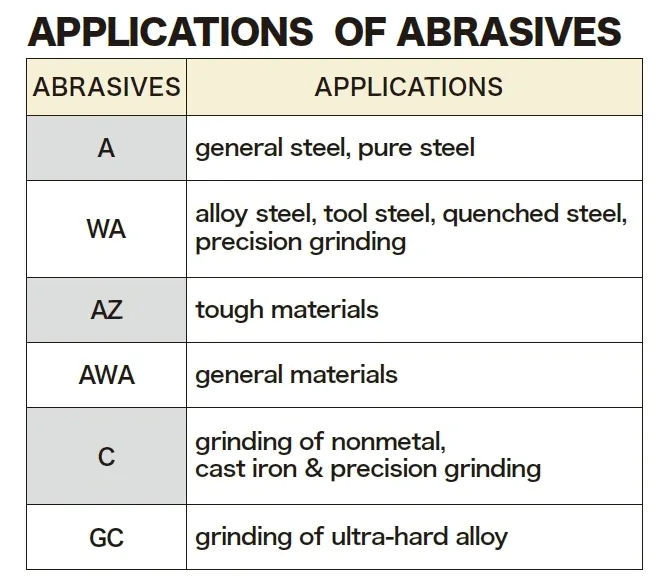
Selection of grains (A, WA, AZ, etc.) based on material hardness and grinding precision.
Warning Symbol Interpretation
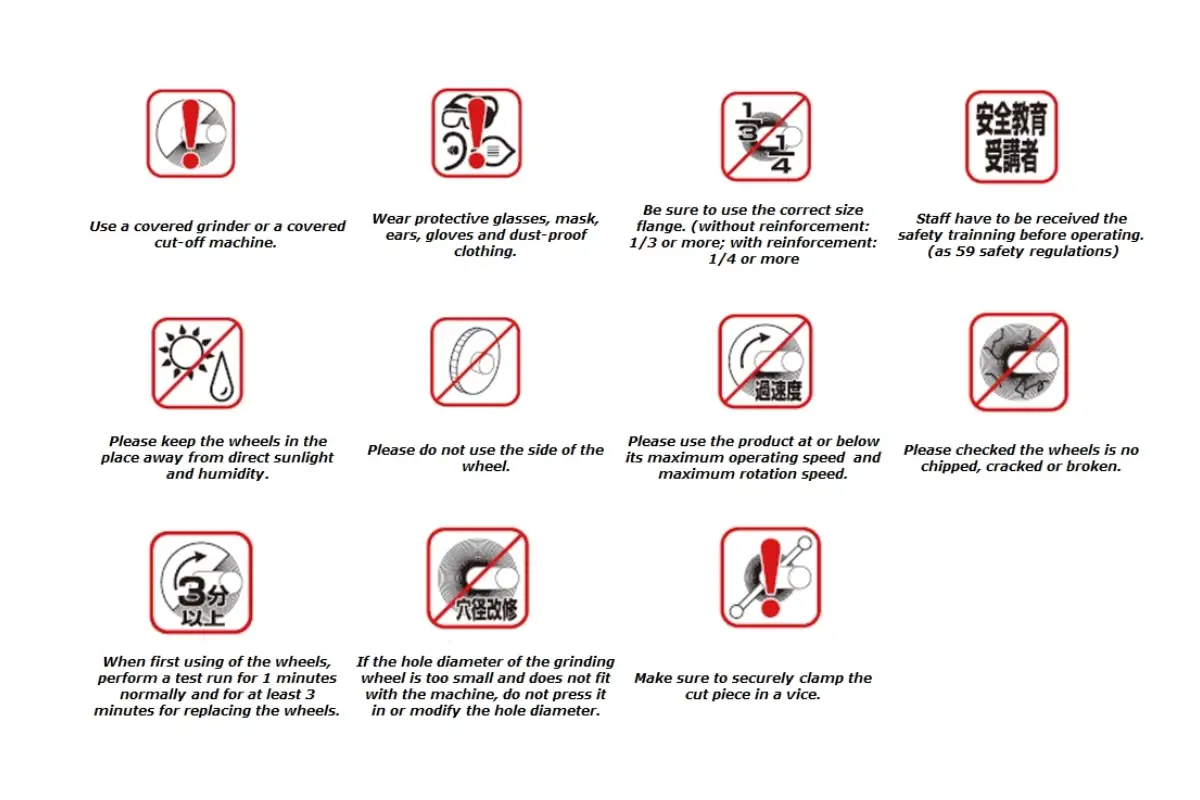
Standardized safety icons for safe operation and protection guard usage.
When deploying Fuji high-performance tools in overseas markets, ensure that the regional power grid frequency and voltage match the tool specifications. To maintain the superior burst speed safety of Fuji wheels, store abrasives in a dry, temperate environment. Humidity can degrade the resin bond, potentially lowering the wheel’s resistance to centrifugal forces.
Fuji products are manufactured following strict Japanese standard process requirements. Every wheel is engineered to meet or exceed JIS (Japanese Industrial Standards), such as JIS R 6242 and B 4051. Our core engineering logic prioritizes maximum operator protection by maintaining safety factors and burst speed capabilities that often surpass the highest industry benchmarks.
| Standard Region | Safety Factor (Burst Multiplier) | Safety Logic & Benchmark |
|---|---|---|
| FUJI (High Precision) | > 2.0x | Engineered to exceed JIS requirements for maximum reliability. |
| Japan (JIS R 6242) | 2.0x | Extreme Safety: A wheel rated at 80m/s must withstand a 160m/s burst test. |
| Europe (EN 12413) | 1.73x | Risk Balanced: Provides high safety redundancy for most industrial apps. |
| USA (ANSI B7.1) | 1.5x | Efficiency Focused: Relies on machine guarding and operational procedures. |
Abrasive Selection Guide
Selection of grains (A, WA, AZ, etc.) based on material hardness and grinding precision.
Warning Symbol Interpretation
Standardized safety icons for safe operation and protection guard usage.
When deploying Fuji high-performance tools in overseas markets, ensure that the regional power grid frequency and voltage match the tool specifications. To maintain the superior burst speed safety of Fuji wheels, store abrasives in a dry, temperate environment. Humidity can degrade the resin bond, potentially lowering the wheel’s resistance to centrifugal forces.
This product strictly complies with the Electrical Appliance and Material Safety Technology Standards (Noise Countermeasures), revised under the Ministry of Economy, Trade and Industry (METI) Ordinance No. 57.
*Official Enforcement Date: April 1, 2013. This ensures maximum electromagnetic compatibility (EMC) and operational stability in industrial environments.

Professional Note: For global industrial procurement, these Japanese METI standards ensure that Fuji tools meet high-level noise reduction requirements, critical for precision workshops across Europe and North America.


