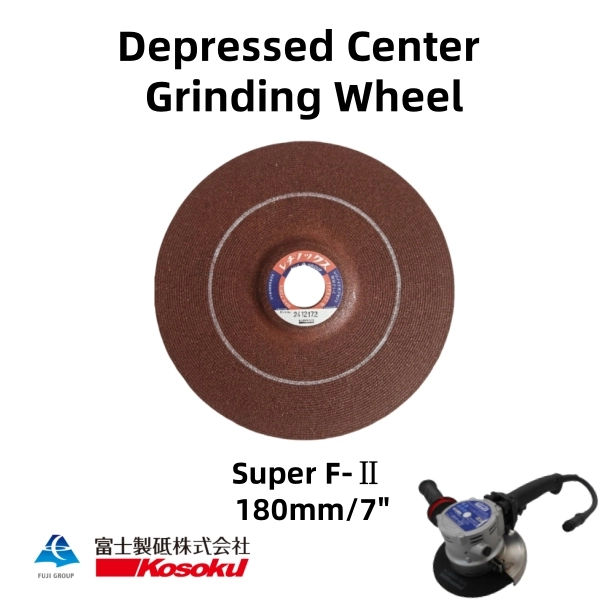
A depressed-center grinding wheel is used for stock removal, weld dressing and edge preparation when the exact wheel is approved for the material and task. Its recessed centre provides clearance around the mounting area. Shape alone does not establish the permitted operation, operating angle or maximum speed.
| Task | Selection focus | Acceptance check |
|---|---|---|
| Weld dressing | A grinding wheel suitable for the weld and parent metal | Required weld profile without excessive removal of the parent metal |
| Edge preparation | Access, wheel dimensions and the specified bevel geometry | Consistent edge profile suitable for the following operation |
| Casting cleanup | Exact casting alloy, stock allowance and machine capability | Removal of unwanted metal without damaging the finished feature |
| Surface finishing | Required finish and whether a flap disc or another finishing tool is more appropriate | Specified surface condition and acceptable rework |
| Cutting material to length | A wheel explicitly approved for cutting with the required guard and machine | A controlled cut to the required dimensions |
Do not use a grinding-only disc for cutting or side-grind with a cutting-only disc. Some products authorize more than one operation; check the specific label and instructions rather than relying on a shape name such as Type 27.
The FUJI Super F-II 180 mm product page is a starting point for discussing larger-area grinding. Confirm the full reference before ordering. Diameter alone does not establish thickness, bore, grade or speed rating.
Follow the wheel and machine manufacturer's operating instructions for the permitted working surface and contact angle. There is no single angle that can safely be applied to every depressed-center abrasive tool. Maintain control and use the specified guard. Do not alter the wheel, remove guarding or increase speed to gain access or removal rate.
Inspect the wheel before mounting and follow the product's storage and validity instructions. Stop if abnormal vibration, damage or other unsafe conditions appear. Reinforcement does not make a wheel unbreakable. Trained operators, workpiece restraint, dust control and appropriate protective equipment remain necessary.
For workshop evaluation, compare accepted parts, grinding time, wheel consumption and rework on equivalent workpieces. See our grinding efficiency and cost-per-part guide for the measurement method.
No. Check the manufacturer's dimensional requirements and the exact metric dimensions, bore and mounting system. A nominal inch description is not a complete compatibility specification.
No. Grade concerns grain retention in the bond. Removal rate and finish depend on the complete specification and operating conditions; evaluate the candidate on the intended job.
Send the material grade, operation, machine model and speed, current wheel label and required finish. Include any restrictions on contamination or workpiece geometry.
Read the wheel marking guide or request help selecting a configuration.


