

A needle scaler attachment can turn a compatible impact driver into a portable surface-preparation tool—but a matching hex connection alone does not confirm compatibility. Before ordering, check the exact driver model, attachment retention, operating settings and intended workload.
The FUJI EISHIN Needle Kogera uses a bundle of reciprocating needles to work on suitable rust, coatings and welding residue. When powered by a compatible battery-operated impact driver, it provides a cordless needle scaler configuration without a compressed-air hose.
However, the attachment is not a complete battery-powered tool. Its performance, handling and operating limits depend on the complete combination of attachment, driver and battery.
This guide helps you decide what is confirmed, what still needs checking and when a different tool may better suit the job.
1. What Does the Attachment Do?
A needle scaler attachment converts motion from its compatible driving tool into repeated needle impacts. The needle bundle works against the surface to loosen suitable deposits.
This makes an impact driver needle scaler worth considering for localized maintenance where access and portability matter. It is a different process from grinding: needles strike the surface, while an abrasive wheel removes material through abrasive contact.
The two EISHIN attachment types also serve different purposes:
| Attachment | Working element | Selection focus |
|---|---|---|
| Needle Kogera | A bundle of needles | Localized deposits and irregular surface features |
| Kogera Basic scraper | A replaceable scraper blade | Tasks better approached with a blade edge and a suitable scraping angle |
Explore the FUJI EISHIN needle scaler attachment for product details. For blade-based removal, compare the KOGERA electric scraper attachment.
Choose between them according to the deposit, underlying material and available access—not simply because both can support rust-removal work.
2. Which Driver Models and Connections Are Approved?
The supplied FUJI catalog identifies a 6.35 mm hex shank and describes use with an impact driver. It does not provide a model-by-model approval list in the material reviewed for this guide.
We therefore do not claim that every impact driver with a 6.35 mm holder is compatible. Nor should a pictured tool be treated as approval for every model from the same brand.
Use the following three-part compatibility check:
| Status | What it means | What to do |
|---|---|---|
| Confirmed combination | The exact attachment and host-driver model have been confirmed for the intended setup and operating conditions | Retain that confirmation and follow the supplied instructions |
| Model awaiting confirmation | The driver appears to have the appropriate connection, but the exact combination has not been verified | Send the model number, holder photographs and operating specifications before ordering |
| Unsupported or unapproved setup | The connection cannot retain the attachment correctly, the required operation cannot be achieved, or an unapproved adapter is needed | Do not proceed with that configuration |
A square-drive impact wrench fitted with a hex adapter is not automatically equivalent to the impact driver described in the catalog. Likewise, do not assume that a drill, hammer drill or rotary hammer is an approved substitute.
For a useful compatibility enquiry, provide:
- The complete driver model number, including any regional suffix.
- A clear photograph of the bit holder and locking mechanism.
- Available speed settings and operating modes.
- The intended attachment model.
- Details of any adapter or extension you propose to use.
Battery voltage and maximum fastening torque alone are not enough to establish approval.
3. What Operating Limits Must You Follow?
The manufacturer’s Needle Kogera leaflet specifies operation in the 2,000-rpm range. It warns that excessive rotational speed can cause clutch slip, reduce impact effectiveness and promote overheating. This is guidance about driver rotation—not a stated needle impact rate. Follow the instructions supplied with your actual attachment and driver when selecting the setting. Read the manufacturer’s leaflet (PDF).
Do not assume that the driver’s highest speed setting is the correct one.
Before work:
- Inspect the attachment, needle set and mounting components.
- Confirm correct shank retention.
- Install and use the supplied handle as instructed.
- Secure the workpiece and check available clearance.
- Confirm the required protective equipment and controls for flying debris, dust, noise and vibration.
During a trial, monitor both cleaning results and tool condition. Stop if the connection loosens, needles become damaged, operation becomes abnormal or heating indicates a problem.
No universal continuous-running time is stated here. An attachment demonstration does not establish an unlimited duty cycle. Follow the applicable instructions and obtain clarification if your planned workload involves prolonged repetitive use.
4. Which Rust, Paint and Slag Removal Tasks Fit It?
The catalog identifies applications such as rust and coating removal around bolts and nuts, work around handrail recesses, welding-slag removal and ship-maintenance deposits.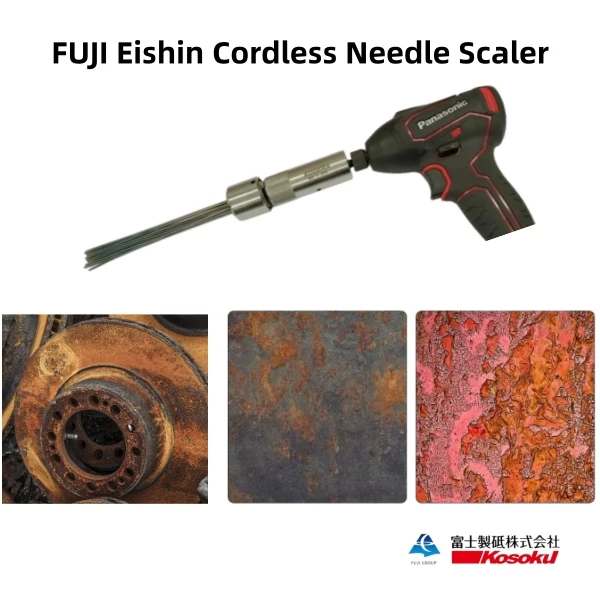
The practical question is whether the needles can remove the deposit without leaving an unacceptable condition in the underlying material.
| Task | What to establish in a trial |
|---|---|
| Rust around fasteners and uneven features | Whether the needles can reach the deposit without damaging adjacent components |
| Coating removal on suitable metal | Whether the coating releases and the resulting surface meets the next process requirement |
| Welding-slag removal | Whether residue is removed without unacceptable damage to the weld or surrounding material |
| Localized maintenance cleaning | Whether access, handling and working time suit the complete tool combination |
Use extra care when evaluating thin, delicate or appearance-critical material. A surface that looks cleaner may still show impact marks.
Identify existing coatings before removal and apply the required exposure controls. Needle scaling alone should not be described as proof of a specified coating-preparation grade or surface profile.
For attachment configurations and catalog dimensions, see the existing FUJI EISHIN needle scaler models and compatibility guide.
5. When Is a Dedicated Scaler More Appropriate?
A cordless attachment setup can be convenient when moving between small maintenance tasks. That convenience does not mean it replaces every pneumatic or dedicated electric scaler.
Consider a dedicated machine when your work requires:
- A documented duty rating for sustained operation.
- Established vibration or noise data for the proposed configuration.
- A particular needle arrangement or access geometry.
- A production process already supported by suitable compressed-air infrastructure.
- Predictable performance across repeated, comparable tasks.
Compare complete systems rather than attachment weight alone. Include the driver, battery, handles and other required equipment when assessing balance and reach.
A meaningful comparison records the same surface condition, cleaned area, working time, consumable use and acceptable finish. Avoid claiming that one system is universally faster, lighter or more economical without a controlled comparison.
For a blade-friendly removal task, the KOGERA scraper may be worth evaluating. For controlled metal removal or weld leveling, a suitable grinder and abrasive may be a different, more appropriate process.
6. What Surface Does the Demonstration Actually Show?
The existing FUJI EISHIN demonstration should be viewed as an example of a particular setup and task—not as approval for every driver or every surface.
When reviewing a demonstration, separate three kinds of evidence:
Connection evidence
Can you identify the attachment’s shank, the driver holder and how the assembly is retained? A tool color or brand logo does not establish the exact model.
Operating evidence
Can you identify the driver setting, needle set and duration of operation? A short clip does not establish continuous-duty capability or battery runtime.
Surface evidence
Is the material or coating identified, and can the same area be compared before and after cleaning? A visible change in appearance does not establish a measured surface profile, remaining coating thickness or readiness for repainting.
If the demonstration does not identify the substrate, treat it as unidentified. Do not label a dark deposit as rust, paint, mill scale or welding slag solely from its appearance.
Use the video to understand the working arrangement. Use a trial on your own material to decide whether the result is suitable for your maintenance or coating procedure.
7. What Should You Confirm Before Ordering?
Prepare a short application record before requesting a quotation:
| Information to provide | Why it matters |
|---|---|
| Driver brand and exact model | Allows the host-tool combination to be checked |
| Holder photographs and any proposed adapter | Clarifies connection and retention |
| Available operating settings | Helps assess whether the required operation can be followed |
| Attachment and needle-set preference | Identifies the configuration being requested |
| Base material and thickness | Helps assess the risk of unwanted surface damage |
| Rust, coating or residue condition | Defines what must actually be removed |
| Access photographs | Shows working clearance and nearby components |
| Expected daily workload | Helps assess whether an attachment or dedicated machine is more appropriate |
| Required finished condition | Defines what a successful trial must achieve |
| Package contents and replacement needles | Avoids assumptions about what is included |
Confirm your driver and attachment combination
Ask for confirmation of your exact combination—not simply whether the attachment “fits an impact driver.”
Contact FUJI with your driver model and application photographs. These details help establish the appropriate next step: confirm the proposed setup, investigate a different configuration or evaluate another surface-preparation tool.
Ask FUJI to Check Your Setup


