

Use a powered wire brush for loose rust and light cleaning. Choose a needle scaler for thick, brittle deposits on uneven steel. Use an electric scraper to lift peeling layers where a blade can reach underneath. Choose a grinding disc when controlled removal of stubborn material or raised metal is needed. The right choice depends on the deposit, surface shape, remaining steel thickness and the next process.
For steel fabrication, shipyard maintenance and equipment repair, these tools often work together. A scraper may lift large flakes. A needle scaler may clean around uneven features. A brush can remove loose residue. Grinding can then treat selected areas that need further correction.
Made in Japan: The FUJI cup wire brushes, EISHIN needle scaler attachments and KOGERA electric scraper attachments featured below are all made in Japan. These quality Japanese-made products provide options for professional cleaning and maintenance, with the right choice depending on the task and tool setup.
Quick Comparison: Four Rust Removal Tools
| Tool | How it works | Where it can help | Main limit |
|---|---|---|---|
| Powered wire brush | Rotating wire tips clean the surface | Loose rust, light oxidation and loose coating fragments | Slow on firmly bonded scale; wires wear and may break |
| Needle scaler | A bundle of needles repeatedly strikes the surface | Brittle deposits around welds, contours and uneven steel | Can leave impact marks; noise and vibration need control |
| Electric scraper | A driven blade lifts or chips deposits | Peeling rust, coating layers and accessible crusts | Blade access matters; poor fit for narrow pits and complex shapes |
| Grinding disc | Abrasive grains cut the surface | Stubborn local deposits, raised metal and controlled blending | Can remove sound steel and generate heat |
No tool automatically delivers a particular surface preparation grade. Check the finished surface against the job requirements.
1. Are You Removing Loose Rust, Heavy Scale or an Existing Coating?
First identify the layer that must be removed.
- Loose rust: Powder, light deposits or flakes that come away easily.
- Heavy corrosion: Thick layers that may hide pits or reduced wall thickness.
- Mill scale: Oxide formed during hot rolling. It may remain firmly attached.
- Existing coating: Paint, epoxy or another layer that may be brittle, flexible or peeling.
- Other deposits: Adhesive, sealant or hardened residue that needs a suitable removal method.
The way a layer breaks or lifts matters as much as its thickness. A brittle deposit may respond well to needle impact. A peeling layer with an exposed edge may suit a scraper. Loose residue may need only brushing.
Before starting, establish the condition of the steel and the requirements of the next process. For old or unidentified coatings, identify potential hazards before producing dust or debris.
Removing rust does not restore metal already lost to corrosion.
2. When Is a Powered Wire Brush Suitable?
A powered wire brush uses rotating wire tips to clean the surface. Common forms include cup brushes, wheel brushes and end brushes.
It is often a practical choice for:
- Loose rust on accessible steel.
- Light oxidation on pipes and small steel structures.
- Loose residue around welds.
- Flaking paint fragments.
- Cleanup after scaling or scraping.
Match the Brush to the Working Area
A cup brush can cover an open surface. A wheel brush can follow edges and narrower paths. A suitable end brush may reach some recesses.
Wire brushing generally removes less steel than aggressive grinding. However, it can still scratch the surface. It should not be treated as precision polishing.
For an available product option, explore Japanese-made FUJI cup wire brushes. Confirm the brush type, mounting connection and rated speed against your grinder and cleaning task.
Recognize Its Limits
A brush may pass over tightly bonded scale without removing it. Deep pits and thick corrosion can take much longer to clean.
Excessive pressure is not a reliable way to improve progress. It can bend the wires and increase wear.
Match the brush size, wire material and speed rating to the tool and workpiece. Inspect it for damage and follow the manufacturer's replacement instructions. Use dedicated, suitable brushes where stainless-steel contamination control is required.
Choose brushing when the main task is light cleaning, rather than breaking thick deposits or reshaping metal.
3. When Is a Needle Scaler Suitable?
A needle scaler uses repeated impacts from a bundle of steel needles to break deposits.
A needle scaler for rust removal can be effective on:
- Thick, brittle rust and flaking scale.
- Uneven steel around welds and fasteners.
- Frames, brackets and structural details.
- Local maintenance areas on ships and industrial equipment.
Individual needles can follow changes in surface height. This can make them useful where a broad brush or flat blade has poor contact.
Uneven Surfaces Are an Advantage—Within Limits
Needles can work around some contours and recessed features. They do not guarantee complete cleaning inside every pit, corner or gap.
The needle bundle and tool body still need clearance. The operator must also be able to control contact and see the working area.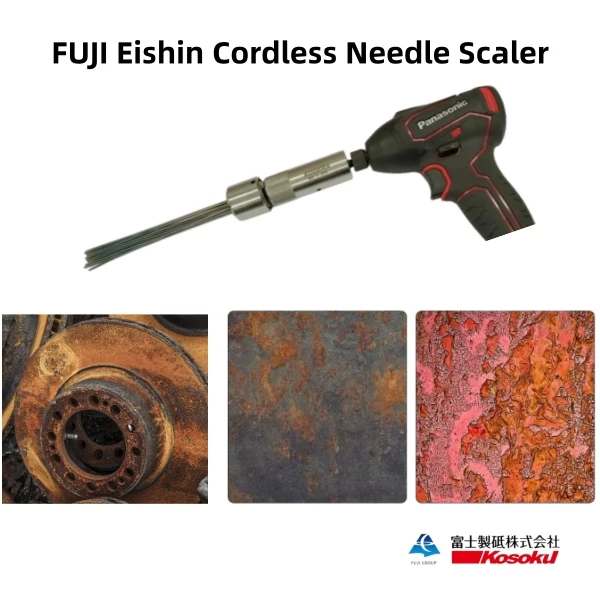
Check for Impact Damage
Needle scaling can mark the steel. Thin sheet and heavily corroded areas may not tolerate the impact.
Noise, vibration, needle condition and working time also affect suitability. Compare the complete working method, not impact strength alone. See HSE guidance on assessing vibration risks for further background.
Separate Tool Selection from Attachment Compatibility
Needle scalers may use pneumatic power, electric power or an attachment system. For an attachment option, see the Japanese-made FUJI EISHIN needle scaler product page.
For more background, read our FUJI EISHIN cordless needle scaler attachment guide. It explains the product options and details to check when considering this setup.
Considering an attachment for your existing driver? Read Will an Electric Needle Scaler Attachment Fit Your Impact Driver? before choosing a setup. Selecting the right tool category does not confirm that a particular driver and attachment are compatible.
Choose needle scaling when brittle deposits and uneven surfaces favor repeated impact.
4. When Is an Electric Scraper Suitable?
An electric scraper uses a driven blade to lift, chip or peel material from a surface.
Some tools have their own motor. Others, such as the EISHIN KOGERA attachment, receive their driving action from a compatible impact driver.
A scraper can be useful when a blade can engage beneath:
- Large, lifting rust flakes.
- Peeling coating layers.
- Accessible hard deposits.
- Suitable adhesive or sealant residue.
Scraper tools also have renovation uses, such as removing floor-covering residue or old coatings. Those applications require the correct blade and do not establish suitability for every steel-cleaning task.
Blade Access Determines the Result
A scraper needs a workable blade angle and an edge or layer it can engage.
It may lift a broad flake efficiently but leave rust beneath it. Narrow pits, weld contours and tight corners may need another tool.
Blade width and shape affect access. A wider blade is not always faster if the surface is uneven or the deposit is strongly bonded.
Avoid Gouging the Steel
An unsuitable blade or steep working angle can mark the base metal. Test the setup before treating a larger area.
For attachment-specific information, see the Japanese-made EISHIN KOGERA electric scraper product page.
Choose scraping when the deposit can be lifted or chipped with controlled blade contact.
5. When Is Grinding Appropriate—and When Could It Remove Too Much Material?
Grinding is appropriate when the job includes deliberate material removal.
Examples include:
- Removing stubborn local deposits.
- Treating raised weld spatter.
- Correcting a high spot.
- Blending an area under an approved repair procedure.
A grinding disc can cut sound steel as well as rust.
Take particular care with thin sheet, corroded sections, edges and weld profiles. Holding the disc in one place or using an overly aggressive abrasive can cause grooves, heat and unwanted thickness loss.
Do not grind a pitted surface flat simply to make the pits disappear. The remaining thickness and repair requirements must guide the work.
Grinding and Stripping Are Different Tasks
Bonded grinding wheels, flap discs and stripping abrasives have different cutting actions.
If the task is coating or rust removal with minimal metal loss, consider a product designed for that purpose. Confirm its suitability for the material and machine. Keep the required guard fitted and use the accessory within its approved limits.
A cutting disc must not be used for side grinding.
Choose grinding when controlled cutting is required and the permitted metal removal is understood.
6. How Do Corners, Welds and Uneven Surfaces Change the Choice?
The tool must reach the deposit without damaging nearby features.
| Working area | Possible starting point | What to check |
|---|---|---|
| Broad plate with loose rust | Wire cup brush | Remaining bonded deposits |
| Broad plate with lifting flakes | Electric scraper, followed by cleanup | Blade angle and marks beneath the flakes |
| Uneven steel with brittle scale | Needle scaler | Impact marks and remaining steel thickness |
| Around bolts or weld contours | Suitable brush or needle scaler | Clearance and preservation of nearby features |
| Narrow pits | Suitable accessible cleaning method | Whether the pit is actually clean; tool reach alone is insufficient |
| Local raised metal on an open surface | Appropriate grinding disc | Removal allowance and final profile |
A combined process may work better than one tool used everywhere.
Example sequence: Scrape lifting flakes → scale uneven areas → brush away residue → inspect and treat remaining spots.
Grinding should have a defined purpose in that sequence. It is not automatically required after brushing, scraping or needle scaling.
7. What Surface Condition Does the Next Process Require?
Rust removal is usually preparation for another task. That task may be inspection, welding, coating or repair. Each can require a different result.
Check three things separately:
| Requirement | Key question |
|---|---|
| Cleanliness | Are the unwanted deposits and contamination removed? |
| Surface profile | Does the texture suit the next process? |
| Component condition | Is the remaining steel acceptable for the intended service or repair? |
A bright surface may still carry contamination. A needle-scaled surface may need further preparation. A scraped area may retain a thin layer beneath the removed flakes.
For coating work, follow the coating supplier's instructions and project specification. Dust, oil and soluble contamination may require separate treatment.
Do not claim that one of these tools automatically achieves a named preparation grade. Use the specified process and inspection criteria.
8. How Can You Compare the Tools on a Test Area?
Use a representative area before committing to the full job.
Compare areas with similar deposits, steel condition and geometry. Set the acceptance criteria before testing.
| Trial item | What to record |
|---|---|
| Starting surface | Deposit type, steel condition and shape |
| Setup | Tool, accessory, blade or needle configuration |
| Total time | Removal, accessory changes, cleanup and rework |
| Cleaning result | Deposits left behind and difficult areas reached |
| Surface damage | Scratches, dents, gouges or unwanted metal loss |
| Consumable wear | Brush, needle, blade or abrasive consumption |
| Working conditions | Handling, dust controls, noise and vibration |
| Acceptance | Whether the area meets the next process's requirements |
Take before-and-after photos with consistent lighting and viewing angles. Label the tool and conditions.
Photos show visible differences. They do not replace required measurements or inspections.
Compare time to an acceptable surface—not just how quickly the first layer comes off.
Frequently Asked Questions
Is a Needle Scaler Better Than a Wire Brush?
For thick, brittle deposits on uneven steel, it may be. A wire brush is often a better starting point for loose rust and lighter cleaning. In a wire brush vs needle scaler trial, compare the finished surface and total working time.
Is a Needle Scaler Better Than an Electric Scraper?
It depends on the deposit and shape. Needle scaling can suit brittle deposits on uneven steel. A scraper can suit layers that lift under a blade. Some jobs benefit from both.
Which Tool Removes the Least Base Metal?
Wire brushing is often a useful starting point for light cleaning with limited metal removal. However, every method can mark or damage the surface if poorly matched or used incorrectly.
Can One Tool Prepare Steel Completely for Painting?
Sometimes a tool can complete the mechanical removal step. Painting readiness still depends on cleanliness, surface profile and the coating system's other requirements.
Find the Right Rust Removal Method
Share your surface photos and the next process with FUJI. We can help you discuss a suitable tool and accessory for a practical trial.
Contact FUJI


