Choose an industrial cut-off wheel by workpiece material, machine compatibility, wheel dimensions and the required cut quality. Then compare cutting time and wheel consumption on a representative job. A disc that works well on thin mild-steel tube may not be the best choice for thick solid bar or contamination-sensitive stainless steel.
This guide focuses on reinforced resin-bonded cut-off wheels for metal fabrication and maintenance. Grinding wheels and flap discs perform different jobs and should be selected separately for the finishing stage.
| Workpiece / task | Selection priority | What to verify |
|---|---|---|
| Mild-steel sheet and thin-wall tube | A narrow cut with controlled feed and limited burrs. | A wheel approved for steel; trial cut time, edge quality and wear. |
| Steel bar, angle and thicker sections | Sustained cutting performance and usable wheel life. | Material grade, section size, machine power and permitted cutting capacity. |
| Stainless steel | Material suitability and contamination control. | An explicitly suitable specification and documented composition limits when required. |
| Aluminum and other non-ferrous metals | A formulation intended for the material. | Manufacturer approval; do not assume a general steel disc is suitable. |
| Rail or machine-specific cutting | The correct wheel for the dedicated machine and material. | Machine type, mounting, speed and application-specific instructions. |
A stainless-steel suitability statement does not automatically mean a disc is free of iron, sulfur or chlorine. Request the limits required by your application and the corresponding product documentation. Keep stainless-steel cutting abrasives separate from those used on carbon steel when contamination matters.
Read the grinder or cut-off machine instructions before selecting a wheel. Confirm its permitted diameter, wheel type, bore, flange arrangement and guard. The machine speed must not exceed the maximum RPM marked on the disc. Never enlarge the bore, remove a guard to fit a larger wheel or transfer a worn machine wheel to an incompatible handheld tool.
Common purchasing dimensions such as 105, 115 and 125mm identify different disc sizes. An inch description alone is not enough to establish compatibility. Match the actual dimensions to the machine specification.
| FUJI Super Tsurugi example | Where to start |
|---|---|
| 105 × 1 × 16mm | Compact 105mm cutting disc for compatible 4-inch angle grinders. |
| 115 × 1.2 × 22.23mm | 115mm / 4.5-inch option for machines permitting that size and mounting. |
| 125 × 1.3mm | 125mm / 5-inch option; confirm the bore and marked speed on the selected specification. |
For large-diameter cutting wheels, check the stated machine and material application rather than selecting by diameter alone. A rail-cutting wheel, chop-saw wheel and portable angle-grinder disc are not automatically interchangeable.
A thinner disc removes less material to form the kerf and can be useful for sheet, tube and small profiles. It may reduce cutting effort, but it does not guarantee a burr-free edge or eliminate heat discoloration. Workpiece support, feed, disc selection and machine condition still affect the result.
A thicker approved disc may suit a different workload or wear requirement, but it also produces a wider kerf. Compare the permitted options on the actual section. Do not select a thicker cutting disc as a way to make side grinding acceptable.
For example, evaluate a thin steel-cutting disc on repeated tube cuts by measuring completion time, burr removal and usable life. For solid bar, repeat the comparison on the real bar size; results from thin tube should not be transferred directly.
The abrasive supplies cutting edges, the resin bond holds the grains, and fiberglass mesh reinforces the wheel. Grain size and bond grade affect how the disc cuts and wears; bond grade describes grain-holding strength, not the hardness of the abrasive itself.
FUJI Super Tsurugi is an economical cutting-disc series. The 105 × 1mm version uses selected corundum abrasive, a resin bond and fiberglass reinforcement on both sides. It is produced in FUJI's own factory using a warm-press process. The combination is intended to balance sharp cutting and practical cost for metalworking.
Double-sided reinforcement supports the disc structure during its intended use. It does not make a cutting wheel unbreakable or permit twisting, side loading or overspeed operation. Verify the construction of each specification rather than assuming every size has identical reinforcement.
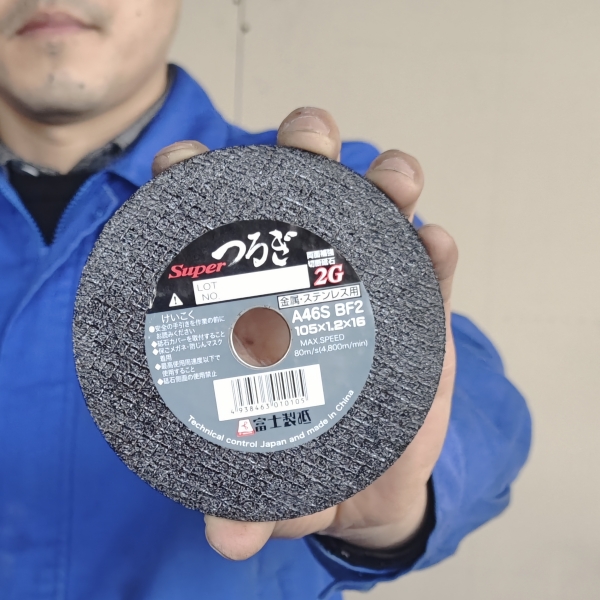
Use a repeatable trial on the same material grade, section, machine and acceptance criteria. Record cutting time, acceptable cuts per disc, burrs, heat discoloration and changeover time. Include any secondary finishing needed to meet the drawing or customer requirement.
Disc cost per acceptable cut = disc purchase price ÷ acceptable cuts completed per disc. Add labor, changeovers and rework to compare the full process cost. A cheaper disc may cost more per finished part, while a premium disc needs a measurable benefit to justify its price.
G-ratio is the volume of workpiece material removed divided by abrasive-wheel wear volume. It can support controlled comparisons, but cuts per disc and total time are often easier to use in purchasing. A weight-based ratio is a different measure unless densities are used to convert both quantities to volumes.
For the grinding operations that follow cutting, see our metalworking grinding-wheel selection guide. Keep cutting and grinding trial results separate.
Resin-bonded wheels do not sound like vitrified wheels when tapped. A dull sound is not proof that a disc is sound or damaged. Follow the prescribed inspection procedure and do not rely on sound alone. Likewise, wheel shape must be considered when checking distortion; a depressed-centre design is not a flat disc.
Check date markings and the manufacturer's stated service-life limits. Do not apply a universal expiry period or assume every manufacturer marks the date on the same part of the disc.
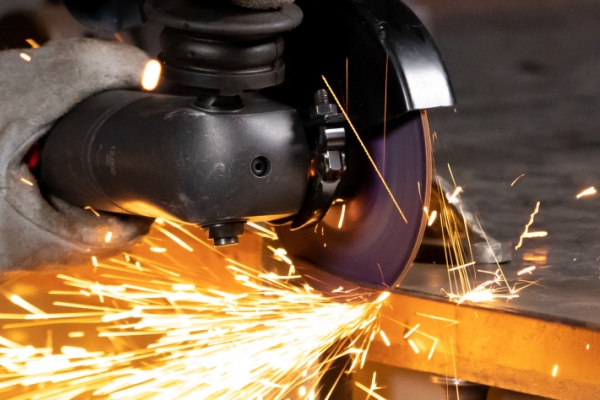
A flap disc may be appropriate for a separate deburring, weld-blending or surface-preparation step. Choose its abrasive, grit and material suitability around the required finish. It is not a substitute for a cutting-off wheel, and a fine abrasive finish is not automatically a polished finish.
If a cut leaves excessive burrs, first review disc selection, workpiece support, feed and tool condition. Measure any remaining finishing time as part of the cutting-process cost rather than hiding it in a separate operation.
No. Thin discs offer a narrow kerf, but selection also depends on the material section, machine and required life. Compare approved thicknesses using cut time, wear and edge quality.
Only when the selected product is approved for both. For contamination-sensitive stainless work, confirm composition limits and avoid using a disc previously used on carbon steel.
Possible causes include unsuitable specification, glazing, excessive contact time, poor support or tool problems. Stop if behavior is abnormal, inspect the equipment and review selection. Do not simply force the disc harder.
No. Ordinary cutting wheels are not designed for that load. Use a grinding or finishing product approved for the operation; only a specifically marked combination product may be used for both.
No. Follow the wheel and machine instructions for flange dimensions, shape, orientation and tightening. Matching the bore alone does not establish compatibility.
Send the metal grade and dimensions, machine model and speed, current disc brand and specification, required quantity and the problem to solve. Photos of the disc label and cut edge help define a useful sample trial.
Tell FUJI your material, section size, machine and quantity, plus your current disc and cutting problems. We can discuss a suitable specification and sample trial, including formulation adjustments where available.
Request a Quote or Sample


